
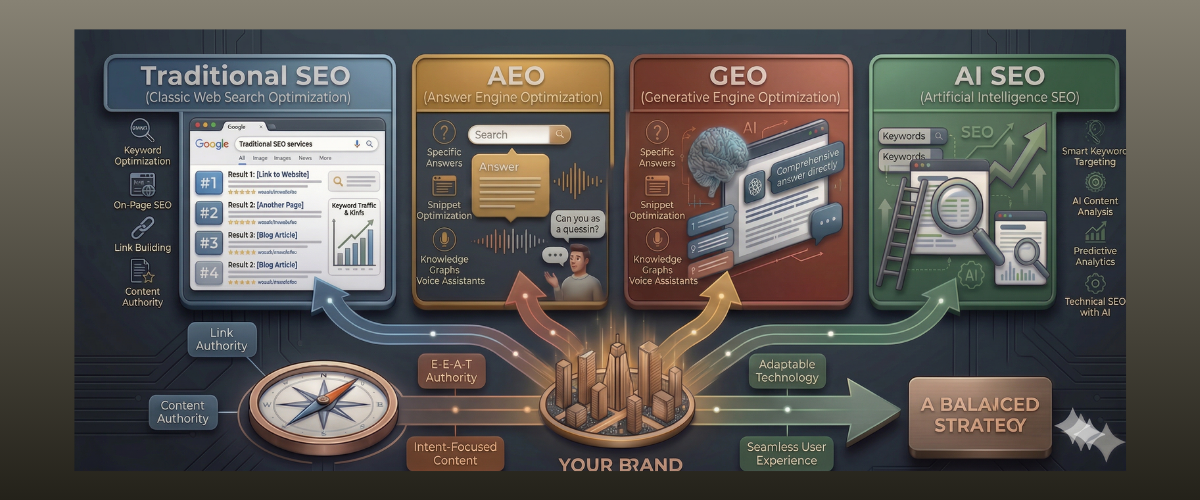

Every marketer is talking about SEO, GEO, AEO, and AI SEO. Most are using the terms interchangeably. Here’s why that matters—and what each one actually means for your brand.
Reading time: 10–12 minutes | Level: Beginner to Intermediate
What You’ll Learn in This Guide
By the end of this article, you will have clear answers to the following:
- What GEO, AEO, AI SEO, and traditional SEO each mean — in plain English
- How they differ in purpose, mechanism, and outcome
- Why the terminology confusion is costing brands visibility
- Which combination your brand actually needs in 2026
- Where to start if you’re building your strategy from scratch
📌 QUICK ANSWER
GEO, AEO, and AI SEO are not competing strategies — they are overlapping disciplines addressing the same fundamental shift: AI is now answering your customers’ questions before they ever reach your website. The brand that understands the distinctions between these approaches will build a more precise, more effective strategy than the one treating them as interchangeable buzzwords.
Table of Contents
1. Traditional SEO, AEO, GEO, and AI SEO—Why the Confusion Exists and Why It’s Costing You Visibility
If you’ve researched AI search optimization recently, you’ve likely encountered a wall of overlapping acronyms: SEO, GEO, AEO, AI SEO. Each one used confidently. Each one defined slightly differently depending on who’s writing.
This isn’t just semantic noise—it’s costing brands real visibility.
When marketers don’t understand the distinction between these disciplines, they default to treating them as variations of the same thing—which means they apply the same strategy across platforms that operate very differently, optimise for the wrong outcomes, and miss the specific opportunities each discipline is designed to capture.
The good news: the distinctions are clear once you see them laid out side by side. And once you understand them, your strategy immediately becomes more targeted and more effective.
2. Traditional SEO vs AEO vs GEO vs AI SEO: Definitions, Differences, and How Each Works
I. Traditional SEO: How It Works—and Where It Falls Short in AI Search
What it is: The practice of optimising web pages to rank higher in traditional search engine results pages—primarily Google.
How it works: SEO focuses on keyword targeting, backlink acquisition, technical site health, and on-page optimisation signals. Success is measured by ranking position, organic traffic, and click-through rate.
What it’s designed for: A world where customers type queries into Google and choose from a list of results. That world still exists—but it’s no longer the whole picture.
Where it falls short in 2026: A page can rank #1 on Google and never appear in a single AI-generated answer. As explored in our complete guide to GEO, traditional SEO rankings and AI citation are two increasingly separate games. Google itself now shows AI-generated summaries on approximately 50% of searches—and only 17% of sources cited in those summaries also rank in the organic top 10.
II. AEO (Answer Engine Optimization): The Bridge Between Traditional SEO and GEO
What it is: The practice of optimising content to appear in direct answer formats—originally developed for voice search and featured snippets, now extended to AI-generated answers.
How it works: AEO focuses on structuring content so that search and AI engines can extract a precise, direct answer to a specific question. This means question-based headings, concise definitions, FAQ formatting, and schema markup that signals the nature of the content to the engine.
What it’s designed for: The moment a potential customer asks a specific question and expects a specific answer—whether through voice search, a featured snippet, or an AI assistant.
Where it sits in the landscape: AEO is best understood as the bridge between traditional SEO and GEO. It emerged when Google introduced featured snippets and voice search changed how people asked questions. It laid the structural foundations that GEO now builds on.
The key distinction from GEO: AEO optimises for extractability—can an engine pull a direct answer from your content? GEO optimises for citation—does the engine trust your brand enough to recommend it by name?
III. GEO (Generative Engine Optimization): Meaning, Strategy, and AI Search Role
What it is: The practice of making your brand visible within AI-generated answers across platforms like ChatGPT, Perplexity, and Google AI Search.
How it works: GEO focuses on becoming a trusted source AI engines cite when generating responses. This involves structured content, strong authority signals, earned media presence, and continuous monitoring of how AI platforms reference sources.
What it’s designed for: A world where customers ask AI systems for recommendations—and those systems respond with a shortlist of trusted brands. The shift to generative search means the goal is no longer just to be found—it’s to be recommended.
Why it’s different from everything else: GEO is the only discipline that addresses the full chain—from how AI engines retrieve content, to how they rank sources, to how they generate and justify recommendations. It is the most comprehensive response to the AI search shift. For a detailed breakdown, see our complete guide to GEO.
IV. AI SEO: What It Means—and Why It’s Often Misunderstood
What it is: An umbrella term covering all forms of search optimization that account for AI’s influence—whether that’s optimising for AI-generated results, using AI tools to improve SEO performance, or adapting strategy to AI-influenced ranking signals.
How it works: AI SEO doesn’t have a single mechanism because it isn’t a single discipline. It’s a collective term that can mean GEO, AEO, or simply modern SEO practice that incorporates AI tools and AI-influenced signals.
Where the confusion lives: Because AI SEO is the broadest term and the highest-volume search keyword in this space, it gets used as a catch-all. A brand that says it’s doing ‘AI SEO’ could mean anything from using ChatGPT to write blog posts to running a full GEO citation strategy.
How to use it correctly: Think of AI SEO as the category. GEO and AEO are disciplines within it. Traditional SEO is the foundation beneath it.
💡 THE KEY INSIGHT
Traditional SEO gets you ranked. AEO gets you extracted. GEO gets you recommended. AI SEO is the strategy that connects all three. Most brands are only doing one — and wondering why the others aren’t finding them.
3. How Traditional SEO, AEO, GEO, and AI SEO Work Together: The Visibility Hierarchy Explained
Understanding how these four disciplines relate to each other is more useful than treating them as separate options to choose between.
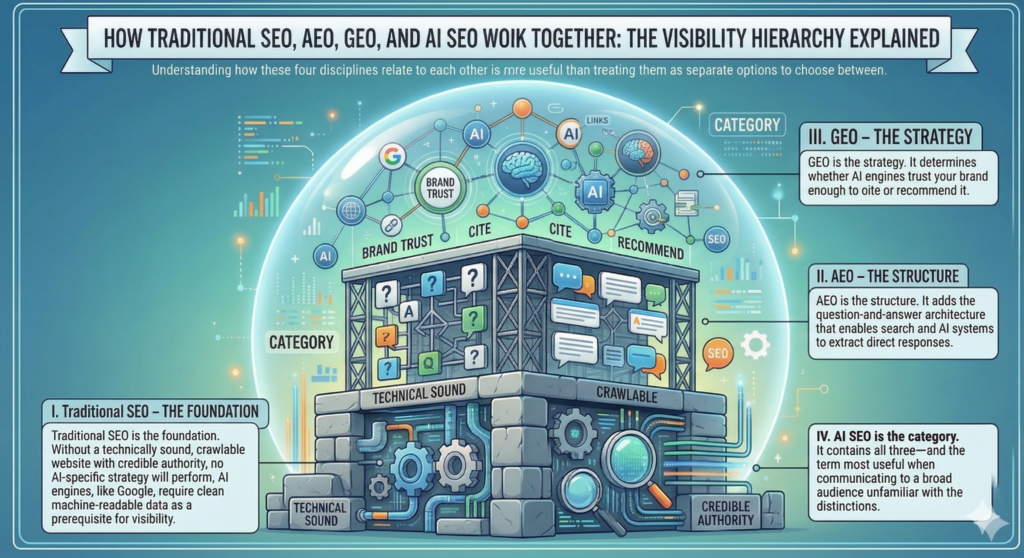
I. Traditional SEO is the foundation.
Without a technically sound, crawlable website with credible authority, no AI-specific strategy will perform. AI engines, like Google, require clean machine-readable data as a prerequisite for visibility.
II. AEO is the structure.
It adds the question-and-answer architecture that enables search and AI systems to extract direct responses.
III. GEO is the strategy.
It determines whether AI engines trust your brand enough to cite or recommend it.
IV. AI SEO is the category.
It contains all three—and the term most useful when communicating to a broad audience unfamiliar with the distinctions.
💡 THE KEY INSIGHT
The brands that win AI visibility aren’t choosing between these disciplines—they’re running all three simultaneously. The question isn’t which one you need. It’s which one you’re missing.
4. What Your Brand Actually Needs — A Framework for AI Search Visibility
The answer depends on where you are in your AI visibility journey. Here’s a simple framework:
No AI Search Strategy Yet? Start with Traditional SEO Foundations
Start with the foundation. Audit your traditional SEO health—technical infrastructure, crawlability, schema markup, and E-E-A-T signals. Without this, nothing above it will work. Then run your AI visibility audit: open ChatGPT, Perplexity, and Google AI Search and ask the 10 most common questions your potential customers ask about your category. That gap between what you find and where your brand should be is your GEO brief. For a step-by-step guide to getting started, see our complete guide to GEO.
Strong SEO but Weak AI Visibility? Add AEO Structure and GEO Authority
Your foundation is solid—but you’re playing a game that’s increasingly being decided somewhere else. The priority is adding AEO structure to your existing content and beginning the earned media work that GEO requires. The most impactful immediate action: identify the top five authoritative publications in your industry that AI engines consistently cite, and pursue coverage in them.
Already Doing AEO? The Missing Piece Is GEO (Citation and Authority)
You have the structure right. The gap is almost certainly in earned media authority and platform-specific optimisation. Review whether your content is being cited—not just indexed—across ChatGPT, Perplexity, and Google AI Overviews specifically. If it isn’t, the issue is trust, not structure.
GEO Strategy in Place? Here’s How to Build Deeper Engine-Specific Intelligence
The next frontier is engine-specific intelligence. Map your citation network for each major AI platform separately. Understand which sources ChatGPT cites for your core queries versus which ones Perplexity cites. These are different — and the gap between them is where your next earned media targets live.
📌 KEY TAKEAWAY
The brands winning AI visibility aren’t the ones with the biggest SEO budgets. They’re the ones that have built verifiable authority across trusted third-party sources, structured their content for machine comprehension, and treat AI citation as an ongoing competitive discipline—not a one-time optimisation task.
5. Difference Between Traditional SEO, AEO, GEO, and AI SEO: Side-by-Side Comparison
| Traditional SEO | AEO | GEO | AI SEO | |
|---|---|---|---|---|
| Goal | Rank in Google results | Appear in direct answers | Get cited by AI engines | Visibility across all AI-influenced search |
| Primary platform | Google, voice search | ChatGPT, Perplexity, Google AI | All platforms | |
| Success metric | Ranking position | Featured snippet capture | Citation rate / Share of Voice | Composite AI visibility score |
| Content format | Keyword-optimised pages | Question-and-answer format | Justification assets, earned media | All of the above |
| Key signal | Backlinks, keywords | Schema, FAQ structure | E-E-A-T, earned citations | Combined signals |
| Time to results | 3–6 months | 4–8 weeks | 3–6 months | Ongoing |
Frequently Asked Questions (FAQs): Traditional SEO vs AEO vs GEO vs AI SEO
No — GEO extends SEO rather than replacing it. Traditional SEO remains the technical foundation on which GEO is built. A brand that abandons SEO in favour of GEO is removing the infrastructure that AI engines depend on to find and index their content in the first place. The two disciplines are complementary, not competitive.
AEO was originally focused on voice search and featured snippets — it’s about structuring content so engines can extract a direct answer. GEO is the evolution of that concept, extended to cover AI engines that don’t just extract answers but generate them, justify them, and recommend specific brands by name. GEO requires everything AEO does, plus earned media authority, entity recognition, and continuous competitive defence.
The primary metric is Share of Voice in AI-generated answers — how frequently your brand appears in responses to your core queries across ChatGPT, Perplexity, and Google AI Search. Track this monthly with a structured manual audit of your 10–15 most important queries. Citation frequency, citation context, and whether you’re appearing in shortlists or just passing mentions are all meaningful signals.
For the foundational layer — technical SEO health, AEO content structuring, basic schema markup — many businesses can make meaningful progress with in-house teams following a clear framework. For the GEO layer — citation network mapping, earned media pipeline, engine-specific competitive intelligence, and Share of Voice monitoring — the complexity and pace of the landscape make specialist support significantly more efficient than in-house trial and error.
Final Thought: The Terminology Will Keep Evolving. The AI Search Shift Won’t.
New terms will emerge as this space matures. The terminology matters less than the underlying reality it’s describing: AI engines are now answering your potential customers’ questions, and those answers include a shortlist of recommended brands.
The brands on that shortlist didn’t get there by accident. They got there by building verifiable authority, structuring content for machine comprehension, and treating AI visibility as the competitive discipline it is.
The question isn’t which term to use. It’s whether your brand is on the shortlist — or watching from the outside while your competitors are recommended instead.
🚀 WANT TO SEE WHERE YOUR BRAND APPEARS IN AI SEARCH
Request a complimentary GEO visibility audit from OddScrew. We analyze how your brand appears across ChatGPT, Perplexity, and Google AI Search—highlighting missed queries, competitor citations, and the steps required to close the gap.The audit takes 48 hours. The insights can shape your visibility for years.