

A strategy that works on Perplexity can fail completely on ChatGPT. Here’s the data on exactly how each platform sources, ranks, and cites content—and what your brand needs to do differently on each one.
Reading time: 13–15 minutes | Level: Intermediate
What You’ll Learn in This Guide
By the end of this article, you will understand:
- Why a one-size-fits-all GEO strategy is leaving significant citation opportunity unrealised
- How ChatGPT, Perplexity, and Google AI Overviews each work mechanically—in plain English
- The specific source preferences, citation behaviours, and content signals unique to each platform
- What your brand needs to do differently on each platform to maximise citation frequency
- How to prioritise your platform-specific effort based on where your audience actually searches
📌 Context
This is Blog 5 in OddScrew’s GEO content series. Blogs 1 through 4 cover what GEO is, how it differs from SEO and AEO, how to audit your AI visibility, and the five strategies that fix AI invisibility. This blog goes deeper—into the platform-specific intelligence that separates brands with good AI visibility from brands with exceptional AI visibility. If you haven’t run your GEO audit yet, start with Blog 3 before reading this.
Table of Contents
1. Why Platform-Specific GEO Strategy Matters
Here is the finding by Avery AI that changes everything about how you approach GEO: only 11% of domains are cited by both ChatGPT and Perplexity, according to an analysis of 680 million citations. A separate 2026 study found a 46x difference in citation rates between AI platforms for the same brand across the same queries.
Most brands still treat AI search as one channel—optimising content once and expecting it to perform everywhere. In reality, these platforms operate as separate ecosystems with different retrieval systems, ranking logic, and source preferences.
What gets cited on one platform may not even be considered on another.
- A Reddit thread can dominate on one platform and be ignored on another
- A Forbes feature can drive citations in one system and have little impact elsewhere
- A well-structured blog post can rank in Google yet never appear in AI-generated answers
This isn’t just about optimisation—it’s about how each platform works.
💡 The Strategic Implication
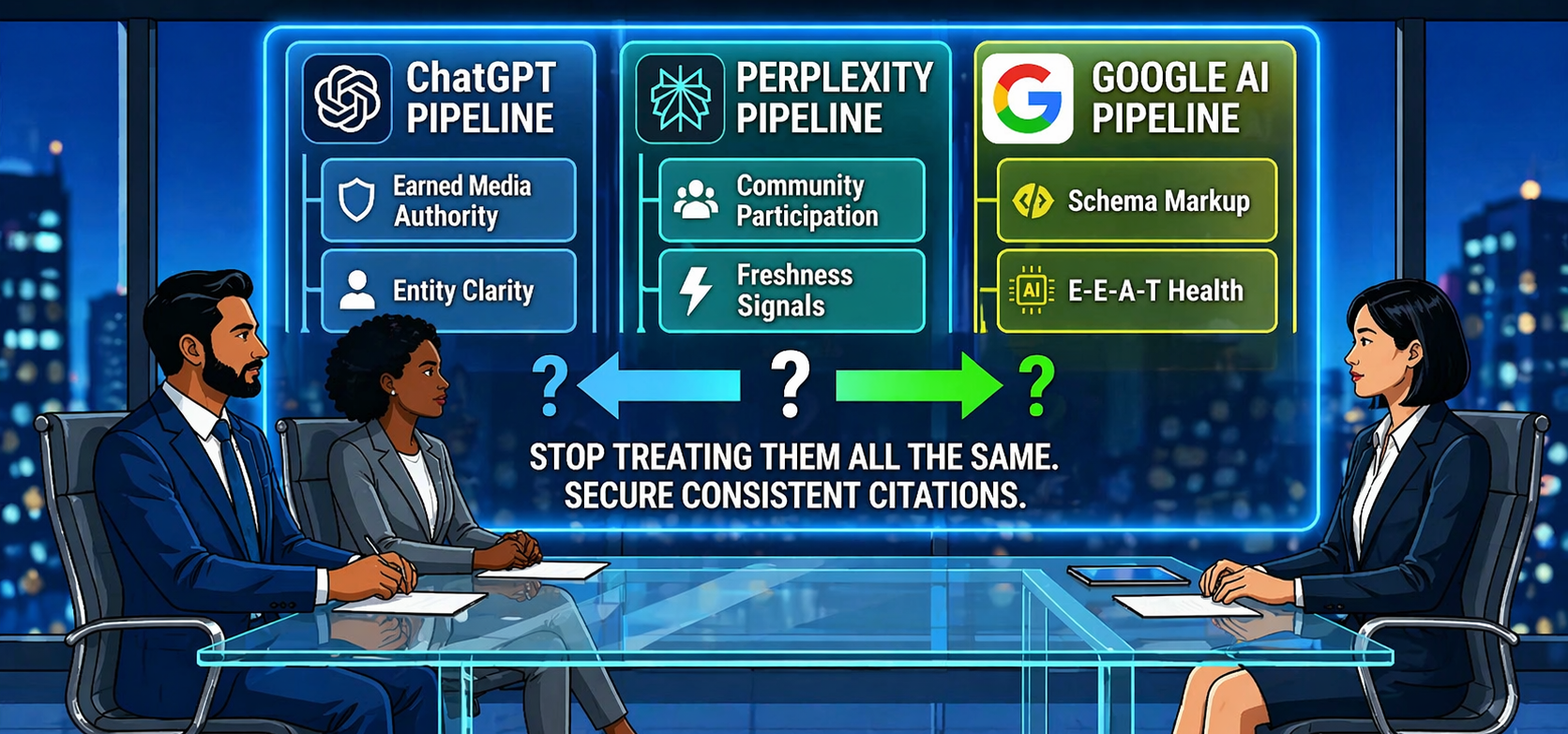
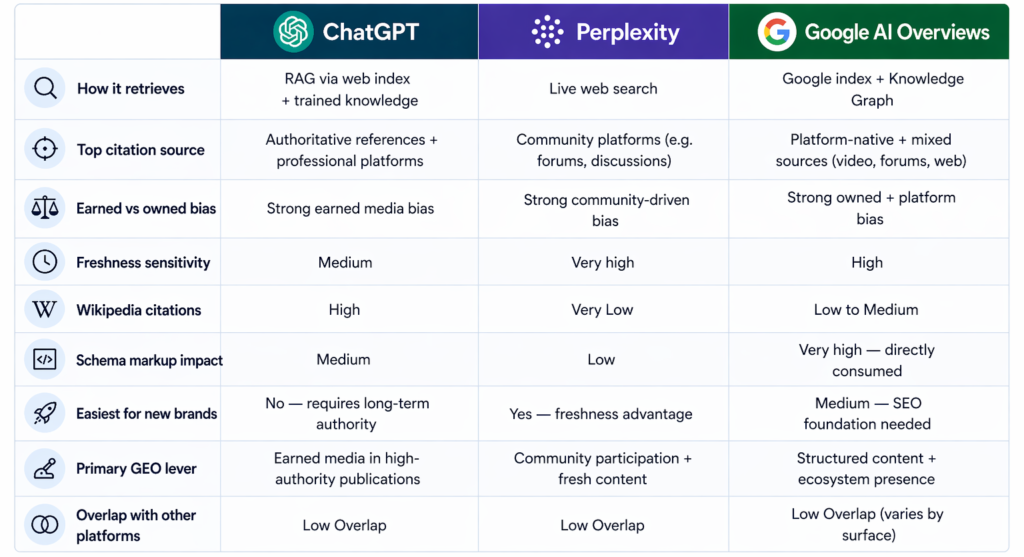
The brands treating all three platforms identically are leaving citations on the table. The foundation—direct answers, clear structure, E-E-A-T signals, schema markup—benefits every platform. But the marginal investment that moves the needle is platform-specific. More Reddit participation for Perplexity. More industry publication mentions for ChatGPT. More schema markup and YouTube for Google AI Overviews.
2. ChatGPT—The Dominant Platform With the Highest Bar
Scale and User Behaviour
ChatGPT is the dominant AI discovery platform by a significant margin. As per PPC Land, It accounts for approximately 87% of all AI referral traffic and processes over 2 billion queries every day as of early 2026. The average query length in ChatGPT has grown from 12 words to over 35 words—customers are articulating nuance, context, and edge cases upfront rather than typing short keywords. They are asking for analysis, recommendations, and comparisons, not just definitions.
How ChatGPT Actually Works
ChatGPT uses a combination of its trained parametric knowledge and live web retrieval through a system called Retrieval-Augmented Generation (RAG). When a query benefits from current information, ChatGPT’s ‘query fan-out’ system generates multiple sub-queries, retrieves results, evaluates the retrieved pages, and synthesises an answer citing the most relevant sources.
A key implication: because ChatGPT’s retrieval can draw from web indexes like Microsoft Bing, being indexed there improves the likelihood of your content being discovered and cited. Bing indexation rates are typically lower than Google’s, meaning there are likely pages on your site that Bing hasn’t indexed and ChatGPT therefore is less likely to cite it. Submitting your sitemap to Bing Webmaster Tools is a foundational step that many brands overlook entirely.
What ChatGPT Cites—The Data
An analysis of 83,670 citations over 54 days by Analyze AI found that ChatGPT uses Wikipedia for 12.1% of its citations—more than 100 times higher than Claude’s 0.1%. LinkedIn is cited by ChatGPT at 4.1% of citations, highlighting a channel many brands have not traditionally considered as a GEO asset. Meanwhile, Search Engine Land reported that Reddit citations surged by 87% in mid-2025 and now represent over 10% of ChatGPT’s cited sources.
The earned media bias is the most structurally significant finding in ChatGPT citation research. University of Toronto research described a ‘systematic and overwhelming bias towards earned media over brand-owned and social content.’ In practical terms, a company with two Forbes features and one TechCrunch profile piece is positioned better for ChatGPT citations on relevant queries than a company with 400 blog posts and no earned media history.
ChatGPT only cites 15% of pages it retrieves. 85% are retrieved but not cited. The difference between a page that gets retrieved and discarded versus retrieved and cited comes down to content structure and authority signals.
Content Structure ChatGPT Rewards
According to research conducted by Kevin Indig, Growth Advisor, 44.2% of all ChatGPT citations come from the first 30% of page content. The middle section contributes 31.1% and the final 30% just 24.7%. This means front-loading answers is not a stylistic preference—it is the single highest-leverage structural change you can make to a page for ChatGPT citation probability.
Pages structured into 120–180 word sections earn 70% more ChatGPT citations than pages with very short sections, according to the same research. According to Authoritas (2025), FAQ schema and inline citations increase citation probability by approximately 40% compared to pages without these elements.
ChatGPT also rewards what researchers call ‘Content-Answer Fit’—how closely a page’s content matches the style and format of the answer the AI intends to generate. ChatGPT writes in neutral, objective, structured prose. Content written in a colloquial, marketing-heavy, or fragmented style requires the model to perform heavy cognitive processing before it can cite it—making such content less likely to be cited even if it ranks well in Google.
📊 ChatGPT GEO Priority
For ChatGPT visibility: build entity authority through Wikipedia presence and LinkedIn content; secure earned media placements in high-authority publications that Bing indexes; front-load every key page with a direct answer in the first 40–60 words; submit your sitemap to Bing Webmaster Tools; and write in clear, objective, structured prose that mirrors the style ChatGPT produces. Authority in third-party sources is the primary acquisition channel for ChatGPT citation pool access.
3. Perplexity—The Most Transparent and the Fastest to Respond
Scale and User Behaviour
Perplexity is the fastest-growing AI search engine in the market. It has 45 million monthly active users and processes between 1.2 and 1.5 billion queries per month as of early 2026—a 370% year-over-year increase. Its user base skews toward research-oriented, technically sophisticated customers who explicitly want cited sources. Technical buyers, researchers, and professionals use Perplexity precisely because it shows its work.
How Perplexity Actually Works
Perplexity is structurally different from ChatGPT in one way that changes everything: it searches the live web for every single query, synthesises results in real time, and cites its sources explicitly in every response. This makes it more like a research engine than a trained model answering from memory.
Unlike ChatGPT, which sometimes generates from parametric memory without citation, Perplexity almost always cites. This transparency is both its primary user value proposition and its primary GEO advantage—citation visibility in Perplexity is highly traceable and measurable in a way that ChatGPT citations are not.
Perplexity uses its own proprietary search technology called Sonar. It does not rely on Bing’s index, which means Bing optimisation does not transfer to Perplexity the way it does to ChatGPT. Perplexity has its own crawling and indexing system, and it prioritises freshness more aggressively than any other major AI platform.
What Perplexity Cites—The Data
The data point that surprises most marketers: according to Profound, a significant share of Perplexity’s top citations come from Reddit—reported at 46.7% in their analysis. Not brand websites. Not traditional industry publications. Reddit. This points to something specific: Perplexity tends to surface content generated by real users responding to real questions, often within active topic-based communities.
As per a study by Seer Interactive, roughly half of Perplexity’s citations come from recently published content (including a large share from 2025), indicating a strong bias toward freshness. In practice, this means a well-structured, timely post can begin appearing in Perplexity results relatively quickly compared to more authority-weighted systems. This makes Perplexity the most accessible platform for newer brands or domains that haven’t yet built the long-term authority profile.
The same Profound analysis also found that Perplexity rarely cites Wikipedia, in contrast to ChatGPT’s higher reliance on it. This gives a clear signal that Perplexity’s citation logic prioritises live, community-generated content over encyclopedic authority.
Content Structure Perplexity Rewards
Because Perplexity cites almost every response and surfaces its sources transparently, the optimisation focus is on being retrieved and selected rather than on being extracted from a large page. Perplexity rewards depth: detailed guides and data-rich posts get cited more than thin overview content. It rewards factual precision—clear, concise, factually dense answers perform better than narrative-heavy writing.
For brands with a freshness disadvantage—whose core content hasn’t been updated recently—Perplexity is the highest-urgency platform to address first. Adding visible ‘Last Updated’ timestamps and refreshing data in existing high-value posts can produce measurable Perplexity citation improvements within 30 days.
📊 Perplexity GEO Priority
For Perplexity visibility: participate authentically in relevant Reddit communities—this is not optional, it is the single highest-leverage action for Perplexity citations; publish fresh, data-dense content consistently and update existing content with current figures; add visible ‘Last Updated’ timestamps to all key pages; write for factual precision rather than narrative style. Perplexity is the easiest platform for new brands to break into—and the fastest to reward content investment.
4. Google AI Overviews — The Broadest Reach With the Most Familiar Foundation
Scale and User Behaviour
Google AI Overviews have the broadest reach of any AI search feature by a significant margin—they have over 2 billion monthly users and appear in approximately 50% of all Google searches as of early 2026. For informational queries specifically, coverage reaches 99.9% of keywords according to upGrowth research. Zero-click behaviour is most acute here: 83% of Google AI Overview sessions end without a click to an external website, and in Google AI Mode that figure rises to 93%.
How Google AI Overviews Actually Work
Google AI Overviews synthesise information from multiple sources indexed by Google, then display the synthesised answer at the top of the search results page with citation links. Unlike ChatGPT and Perplexity, Google AI Overviews operate within Google’s existing search ecosystem—drawing on its Knowledge Graph, ranking signals, and E-E-A-T evaluation framework.
This makes Google AI Overviews the platform where traditional SEO and GEO overlap most directly—but the overlap is smaller than most brands assume. According to BrightEdge research, only 17% of sources cited in AI Overviews also rank in the organic top 10. Google’s AI is actively reaching deeper into its index than traditional organic rankings indicate—specifically looking for content that answers questions in a format AI can extract, regardless of whether that content ranks highly.
What Google AI Overviews Cite—The Data
As per study conducted by Otterly AI, Google AI Overviews show the strongest brand content preference among the three major platforms—59.8% of citations come from brand-owned content, compared to 44.7% for ChatGPT and 28.9% for Perplexity. This makes Google AI Overviews the platform where owned content investment has the most direct return.
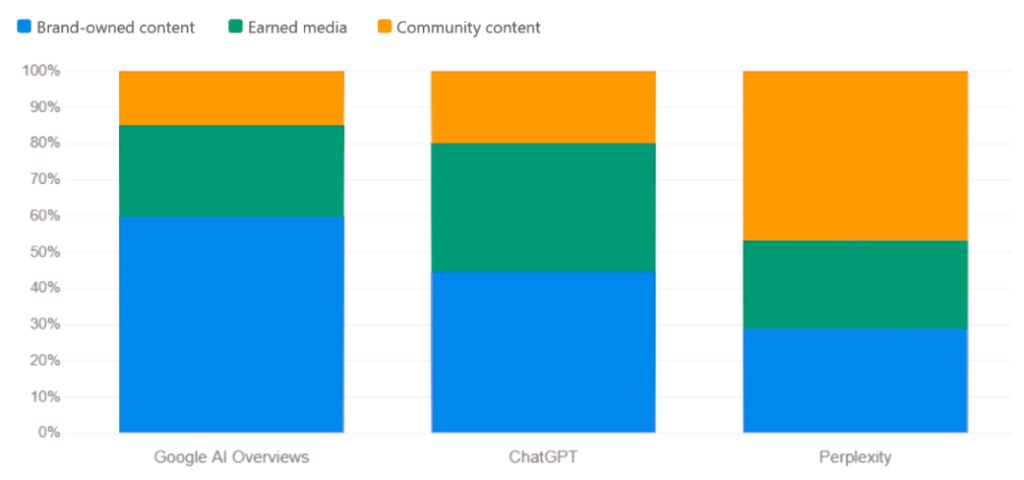
Similarly, analysis by Avery AI indicates that YouTube is particularly prominent in Google AI Overviews, reflecting Google’s integration of its own video platform into AI-generated answers. The same study also highlights the growing visibility of LinkedIn across AI-generated results, particularly for professional and B2B queries
As per a study conducted by Ahrefs, Google AI Overviews and AI Mode cite the same URLs only 13.7% of the time, despite often reaching similar semantic conclusions. This indicates that Google’s different AI surfaces operate with different citation logic—even within the same company’s ecosystem. Brands optimising for AI Overviews cannot assume that visibility automatically transfers to AI Mode.
Content Structure Google AI Overviews Reward
Google AI Overviews reward content that aligns with Google’s existing quality signals—E-E-A-T, technical SEO health, and schema markup—more than the other two platforms. FAQ schema markup is critical here: it signals directly to Google’s AI what questions your content answers and in what format. HowTo schema for instructional content, Article schema for editorial content, and Organisation schema for brand identity are all directly consumed by Google’s AI citation algorithm.
Informational queries drive 57% of AI Overviews according to Semrush research—commercial queries trigger them far less frequently. This means the content strategy most likely to earn Google AI Overview citations is educational and definitional rather than promotional. Brands that have invested in comprehensive ‘What is A’ and ‘How to B’ content are better positioned for AI Overview citations than those whose content focuses primarily on product promotion.
📊 Google AI Overviews GEO Priority
For Google AI Overviews visibility: fix schema markup immediately — FAQ, HowTo, Article, and Organisation schema are directly consumed by Google’s citation algorithm; build informational and definitional content rather than promotional content; invest in YouTube video content that covers your core topics; maintain strong technical SEO health since Google AI Overviews draw on Google’s existing quality signals; and keep content current since AI Overviews are sensitive to freshness signals just as traditional rankings are.
5. Platform Comparison — Side by Side
6. Who Uses Which Platform — And Why It Matters for Your Strategy
Platform choice is not random. Different customer segments gravitate toward different AI search tools based on how they work and what they value. Understanding your customer’s platform preference is as important as understanding the platform’s citation mechanics.
ChatGPT Users
ChatGPT attracts the broadest and most general audience. Its users include professionals using it for work tasks, students for research, and consumers for purchasing decisions. The average ChatGPT user is not specifically looking for cited sources—they are looking for a comprehensive, trustworthy answer. This makes ChatGPT the platform of choice for high-consideration, high-complexity queries where customers want synthesis and analysis rather than a list of links.
Perplexity Users
Perplexity attracts a more specific audience: research-oriented, technically sophisticated customers who explicitly want to verify sources. Technical buyers in B2B, analysts, journalists, and professionals who need fact-checked answers gravitate toward Perplexity precisely because it shows its citations. For B2B brands, Perplexity is disproportionately important relative to its overall market share—the buyer who uses Perplexity is often a more informed, higher-intent customer than the average ChatGPT user.
Google AI Overviews Users
Google AI Overviews users are, in most cases, not specifically choosing AI search—they encounter AI Overviews as part of a standard Google search. This makes it the broadest-reach platform for brand discovery among customers who are not yet AI-native in their search behaviour. For local businesses, e-commerce brands, and any brand whose customers primarily use Google rather than dedicated AI tools, Google AI Overviews is the highest-priority platform by reach.
7. The Universal Foundation — What Works Everywhere
Before investing in platform-specific optimisation, every brand needs the universal foundation that benefits all three platforms simultaneously. Skipping this in favour of platform-specific tactics is building on sand.
Direct Answer Structure
All three platforms reward content that opens with a direct, extractable answer to the question being asked. The question is phrased in the heading. The answer appears in the first sentence of the section. Supporting detail follows. This structure is not a stylistic preference—it is the architecture that all three RAG systems are designed to parse.
Factual Specificity With Named Sources
Vague claims are not citable on any platform. Specific, verifiable, dated data points with named sources are citable on all three. ‘AI referral traffic converts 31% better than other channels, according to Adobe Analytics’ is citable. ‘AI drives better conversions’ is not. Every key claim in your content should be specific, attributed, and verifiable.
Consistent Entity Signals
All three platforms cross-reference multiple sources to build their understanding of your brand. Consistent entity signals — the same brand description, the same positioning, the same factual details across your website, LinkedIn, Google Business Profile, and schema markup—reduce ambiguity and increase citation confidence on every platform simultaneously.
Schema Markup
While schema markup has the most direct impact on Google AI Overviews, it benefits all three platforms by making content relationships explicit and machine-readable. FAQ schema, Article schema, Organisation schema, and HowTo schema are the four types with the highest cross-platform return.
8. Frequently Asked Questions
Not necessarily from day one. Start by identifying which platform your potential customers use most for queries about your category, then build platform-specific optimisation in order of audience relevance. The universal foundation—direct answer structure, entity clarity, schema markup—should be in place across all three before investing in platform-specific tactics.
Perplexity is optimised to surface content that real people generated in response to real questions—community-verified, conversational, and direct. Reddit represents the largest repository of this type of content on the internet. When a potential customer asks Perplexity ‘What is the best GEO agency?’, Perplexity is likely to surface Reddit threads where marketers have discussed and recommended agencies based on real experience. Brands that participate authentically in relevant Reddit communities are building the exact type of content that Perplexity’s citation algorithm is designed to prioritise.
Partially—but less than most brands expect. Strong Google rankings are a useful signal of domain authority that AI Overviews factor in, but they do not determine citation directly. A page that ranks third for a keyword but is structured for AI extraction (FAQ schema, direct answers, informational intent) is more likely to be cited than a page ranking first that leads with marketing copy. SEO is the foundation—AI Overview optimisation is the layer that determines whether that foundation translates into citations.
The most reliable method is to run your 10 core queries across all three platforms manually and observe where your brand currently appears and where competitors appear instead. The platform where your competitors are consistently ahead of you—but where you have a realistic path to catching up based on the citation mechanics described in this article—is your highest-priority platform.
The universal foundation content—structured, direct-answer, factually specific, schema-marked-up—performs reasonably well on all three. But the marginal investments that maximise citation rate are platform-specific: Reddit participation for Perplexity, earned media in high-authority publications for ChatGPT, FAQ schema and ecosystem presence for Google AI Overviews. The most efficient approach is to build universal-foundation content first, then layer platform-specific amplification on top of the pieces that matter most for each platform.
Final Thought: The Platforms Are Different Machines. Treat Them That Way.
The data is unambiguous. Research shows that only 11% of domains are cited by both ChatGPT and Perplexity, a 46x difference in citation rates exists between platforms for the same brand, Wikipedia is cited 100 times more by ChatGPT than by Claude—these are not marginal differences, they are structural divergences that demand different strategies.
The brands building genuine AI visibility are not running one GEO programme. They are running three parallel programmes that share a common foundation but diverge strategically at the platform level. They know that their Reddit participation builds Perplexity citations, their Forbes feature builds ChatGPT authority, and their FAQ schema drives Google AI Overview appearances—and they invest in each intentionally.
Understanding the machines is what separates strategic GEO from guesswork. You now understand the machines. What you do with that knowledge is the difference between being on the AI shortlist—and watching your competitors be recommended instead.
🚀 Ready for Platform-Specific GEO Strategy?
OddScrew’s GEO visibility audit maps your brand’s citation performance across ChatGPT, Perplexity, and Google AI Overviews separately—showing you exactly where you stand on each platform, which competitors are ahead on each, and what the platform-specific action plan looks like for your brand. Book your complimentary audit today. The audit takes 48 hours. The advantage lasts years.