


Ask an AI engine to compare an enterprise IT company with its market alternatives, and it tells you they aren’t comparable at all. Ask that same engine to name the company’s direct competitors, and it loops right back to the exact platforms it just dismissed. That’s not a glitch. It’s a signal conflict—one of the more complex challenges in Generative Engine Optimization (GEO), and one that gets more common the larger and more multi-faceted a company becomes.
Our audit of Torry Harris Integration Solutions (torryharris.com) shows how a split digital footprint pushes AI models into contradictory positioning—and creates real friction in the B2B buyer journey.
Audit At-a-Glance
| Brand | Torry Harris Integration Solutions (torryharris.com) |
| Category | Enterprise API Management & Integration Services |
| Competitors Tested | MuleSoft, WSO2, Boomi |
| Platforms Tested | ChatGPT, Google Gemini |
| Prompts Run | 15 per engine (30 total) + follow-up probes |
| Date Conducted | 17 June 2026 |
| Scores | SEO Health 67 · AI Readiness 67 · AI Visibility 46 (Recognized) |
| Key Finding | AI doesn’t lack information about Torry Harris—it can’t settle on one classification. Depending on how a prompt is worded, it treats the company as an API platform vendor (naming MuleSoft as a competitor) or a systems integrator (calling MuleSoft a partner). A buyer following a normal research path hits contradictory positioning at every step. |
| Headline | Recognized by AI, but positioning is unclear—Torry Harris is read as both an API platform vendor and a systems integrator, which limits recommendation visibility |
Why This Audit Exists
This is the fourth entry in our AI Visibility Mini Audit Series—complimentary, published audits for brands who request one. Each audit covers technical foundations, on-page and off-page SEO, and a structured set of AI prompts across the major platforms.
Most brands we audit share a familiar gap: they’re recognized but not yet recommended at the category level, usually because the off-site signals AI relies on aren’t fully built.
Torry Harris has a different problem. The signals that exist don’t add up to one clear classification. The firm genuinely operates in two modes—a systems integration and consulting practice alongside a proprietary API Manager product—and depending on how a question is worded, AI latches onto one identity or the other.
See the full audit in action
The article below focuses on the key findings, but if you’d like to review the complete scorecard, prompt analysis, and recommendations, we’ve embedded the full report and a video breakdown of the audit.
- Audit Walkthrough Video
- Full Audit Report
Table of Contents
How This Audit Works
For readers new to the series, we measure two things separately.
Readiness (the inputs) – Can AI find, crawl, and parse the site? Scored across technical, on-page, and off-page checks.
Visibility (the output) – Does AI actually identify and recommend the brand? Measured empirically: real prompts, real engines, recording what they say.
We ran 15 prompts each on ChatGPT and Google Gemini, in fresh, logged-out sessions to strip out personalization. The prompts split into three groups: brand identity, category recommendation, and direct comparison.
The Scores
| Lens | Score | Read |
| SEO Health | 67 / 100 | Partial—key fundamentals need work |
| AI Readiness | 67 / 100 | Partial—foundations exist but incomplete for AI |
| AI Visibility | 46 / 100 | Recognized |
| Engine | Score (of 15) |
| ChatGPT | 9 |
| Gemini | 9.5 |
On the technical side, the site renders cleanly without relying on heavy JavaScript and is fully mobile-friendly. But several friction points hold the readiness score back: no robots.txt file (so AI agents get no explicit crawl directives), a multi-hop redirect chain (http → https → www), schema markup with validation errors, and an unstable homepage H1.
A Visibility score of 46 lands the brand in the “Recognized” band—AI knows exactly who the company is, but doesn’t have the confidence to volunteer it during unprompted market discovery.
The baseline numbers, though, aren’t the real story. The real story is the conversational whiplash that appeared when we moved from simple brand lookups to competitive comparisons.
The Identity Disconnect
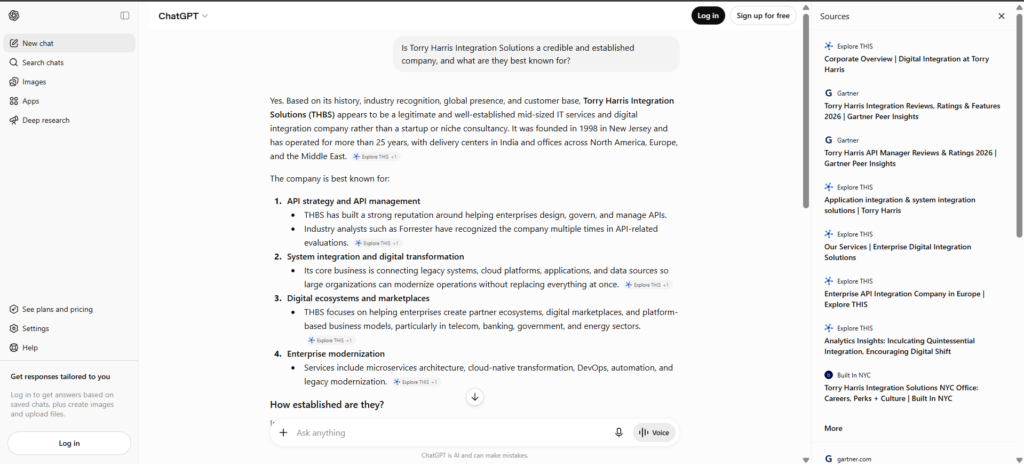
At the discovery level, performance is mostly stable. Gemini mapped the brand cleanly across all five identity prompts—services, target market, pricing. ChatGPT got four of five clean.
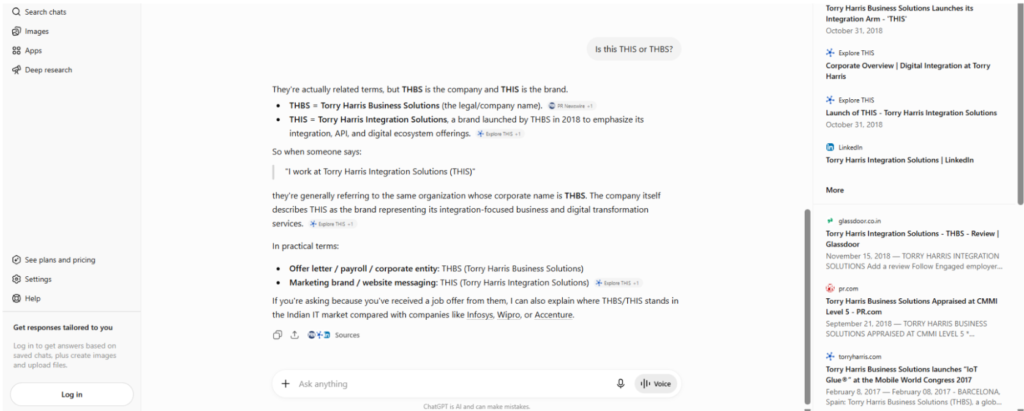
The fifth is worth a brief note. In one identity prompt, ChatGPT answered using the company’s legacy corporate name—THBS (Torry Harris Business Solutions)—even though the prompt used the full “Torry Harris Integration Solutions.”
The engine clearly understands the relationship—pushed with a follow-up, it explained that “THIS” is the brand launched in 2018 to represent the company’s digital integration focus, while THBS is the older corporate entity. It’s not that AI is confused. It’s that the output can momentarily confuse the buyer: someone evaluating a specific vendor is forced to pause and work out whether they’re looking at the right company. Four of five prompts were clean, so this is an occasional slip rather than a pattern—but it’s the kind of friction that chips at confidence during evaluation.
Category Recommendations: The Dead Zone
When we stepped away from branded queries and simulated an unprompted buyer search—“What are the best Enterprise API Management & Integration Services?”—Torry Harris Integration Solutions scored zero on both engines.
The lists were built from the predictable tier-one names: MuleSoft, Apigee, WSO2, Kong, Boomi, IBM, SAP. Torry Harris Integration Solutions was absent every time.
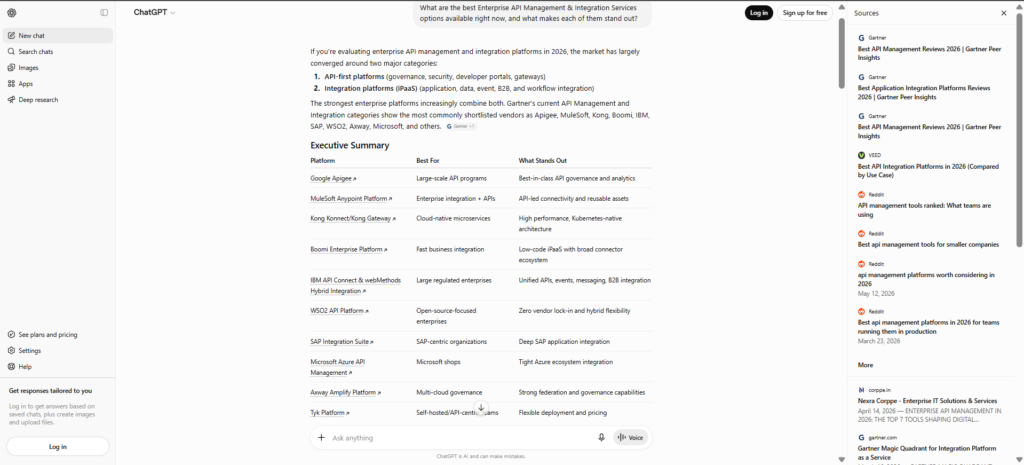
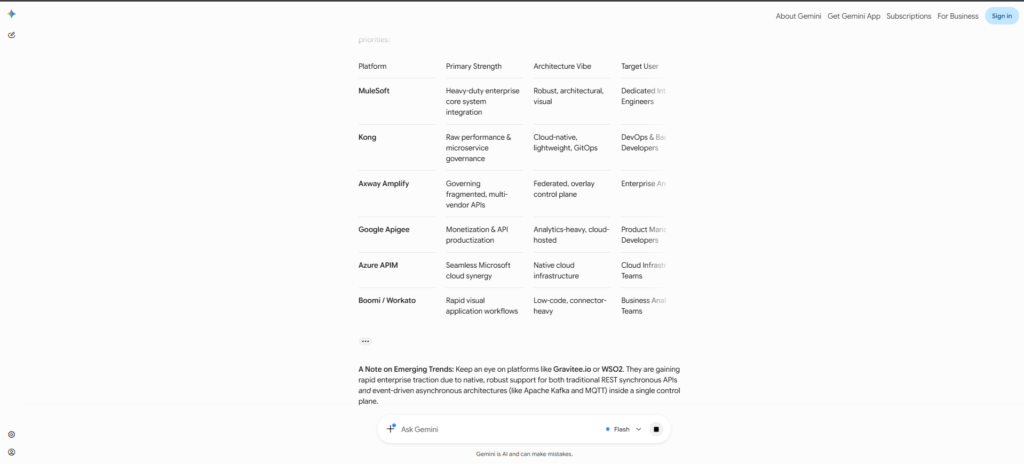
By itself, missing the organic category shortlist is a common hurdle—the hardest tier of AI visibility to unlock, because it demands a dense, authoritative off-site footprint. What happened next is the defining finding of this audit.
The Comparison Paradox
The real breakdown shows up when a buyer tries to evaluate alternatives side-by-side. Here, the engines locked into contradictory positioning driven entirely by how the prompt was framed—and, revealingly, they didn’t even stay consistent within the comparison group itself.
Step 1 – Direct head-to-head evaluations
Because Torry Harris named MuleSoft, WSO2, and Boomi as its competitors, we started there: “How do Torry Harris Integration Solutions and MuleSoft compare, and which would you recommend?”
For MuleSoft, ChatGPT rejected the premise outright: “They’re not direct equivalents.” It cast Torry Harris as an implementation, architecture, and consulting firm, and MuleSoft as a core software platform (iPaaS)—then went further and labeled Torry Harris a partner to MuleSoft, not a rival. It largely declined to give a real head-to-head.
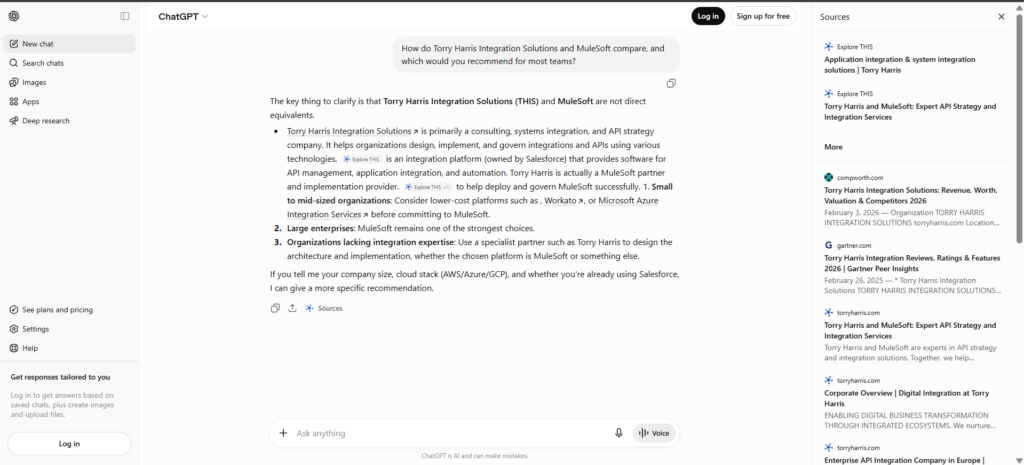
But for WSO2 and Boomi, something different happened. ChatGPT opened with the same caveat—”not apples-to-apples,” “platform vendor vs. integration services firm”—and then produced a full comparison anyway: a “Key Differences at a Glance” table, an offering-by-offering breakdown, and a long-term recommendation verdict.
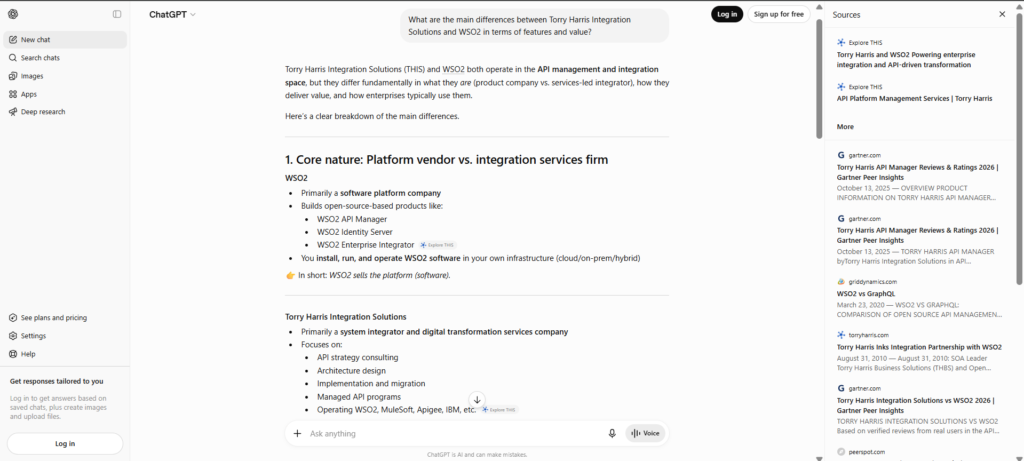
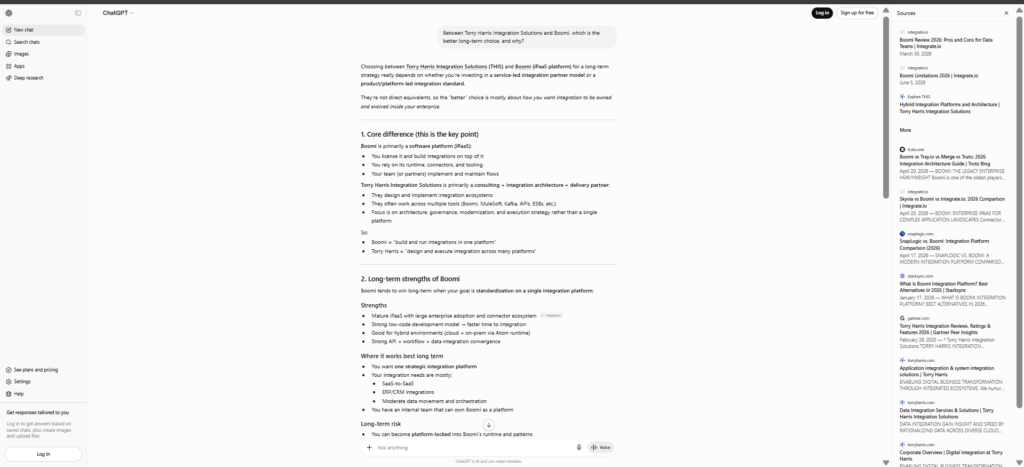
So the engine doesn’t apply its own logic consistently. The one competitor it explicitly frames as a partner (MuleSoft) is the one it won’t compare. The other two get the disclaimer—then a complete comparison. Gemini showed the same tendency: it framed the MuleSoft question as “hiring a systems integrator versus buying a platform,” while still generating comparison tables for the others.
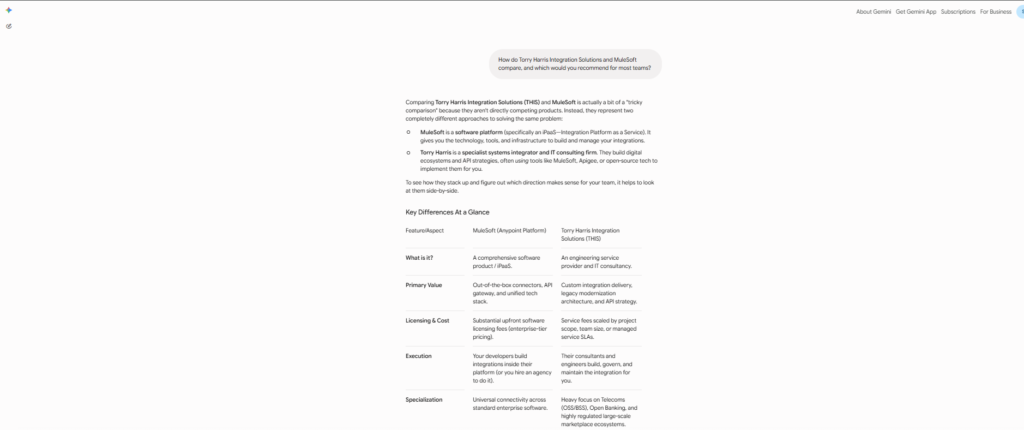
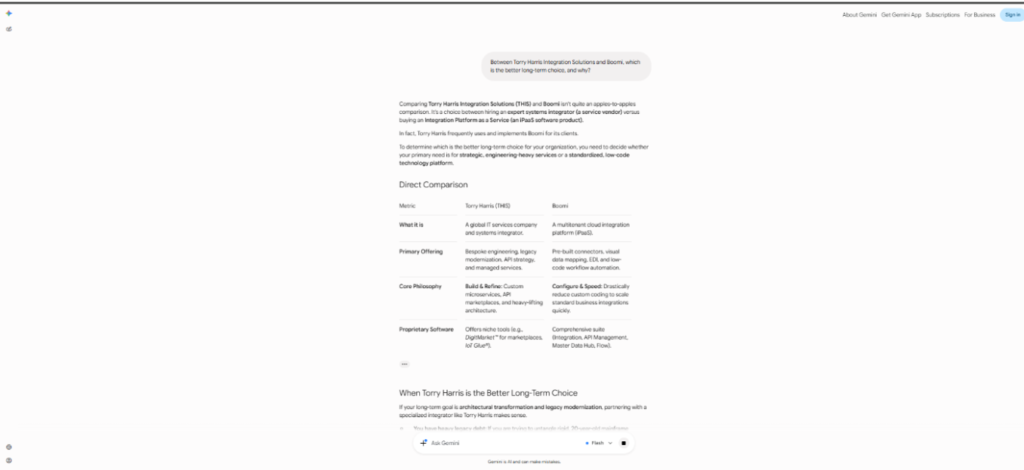
That difference is reflected in how we scored each comparison. The MuleSoft prompt is marked Partial—the brand never entered the comparison as a real alternative; AI reframed it as a partner instead. The WSO2 and Boomi prompts are scored as full comparisons—the “platform vs. services” caveat is accurate context, not a demotion, and in both cases the brand was presented as a genuine option a buyer could weigh side-by-side. Same brand, same category, three competitors—and three meaningfully different outcomes.
Step 2 – The competitive counter-probe
The comparison prompts raised an obvious question.
MuleSoft, WSO2, and Boomi weren’t chosen at random—they came directly from Torry Harris as representative competitors. Yet during the head-to-head evaluations, AI repeatedly qualified the comparisons by saying the companies represented different business models, and in MuleSoft’s case, even reframed the relationship as partner rather than competitor.
That led to a simple follow-up question: was the original competitor set wrong? To test that, we stepped back and asked the engines a neutral question instead:
Who are the direct competitors to Torry Harris Integration Solutions?
If AI genuinely believed these companies weren’t comparable, we expected it to return a different set of competitors altogether.
It didn’t.
Instead, both engines independently surfaced the same names: MuleSoft, WSO2, Boomi, Apigee, IBM, Oracle, and other enterprise integration vendors—the very companies they had just hesitated to compare directly.
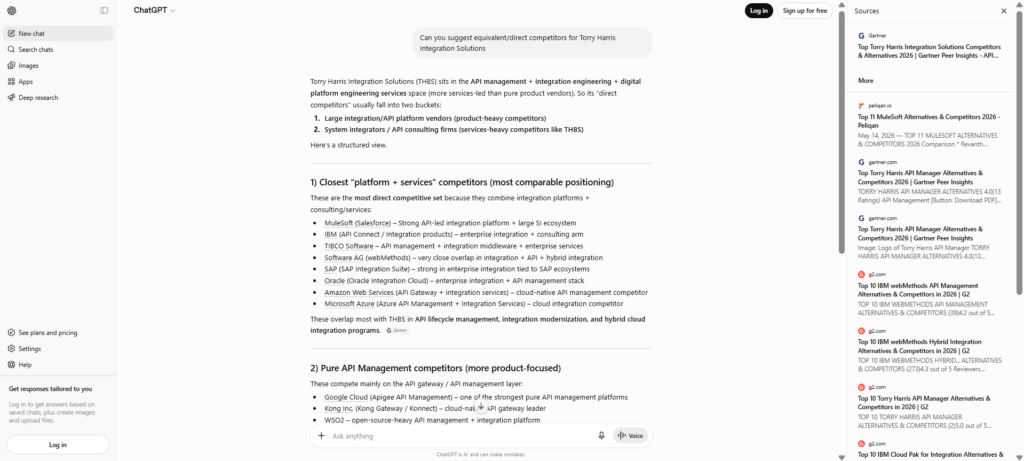
At first glance, that looks like a contradiction. But when we pushed ChatGPT to explain why these companies were considered competitors despite representing different business models, the reasoning became much more interesting.
Rather than abandoning its earlier position, the model separated competitors into distinct groups: API platform vendors, enterprise integration platforms, and systems integration and consulting firms. It explained that competition depends on the buyer’s objective. An organization selecting an API management platform might evaluate MuleSoft, WSO2, or Boomi. Another looking for integration strategy, implementation, or modernization services might evaluate Torry Harris alongside consulting-led firms. And in large enterprise transformation programs, those buying journeys frequently overlap.
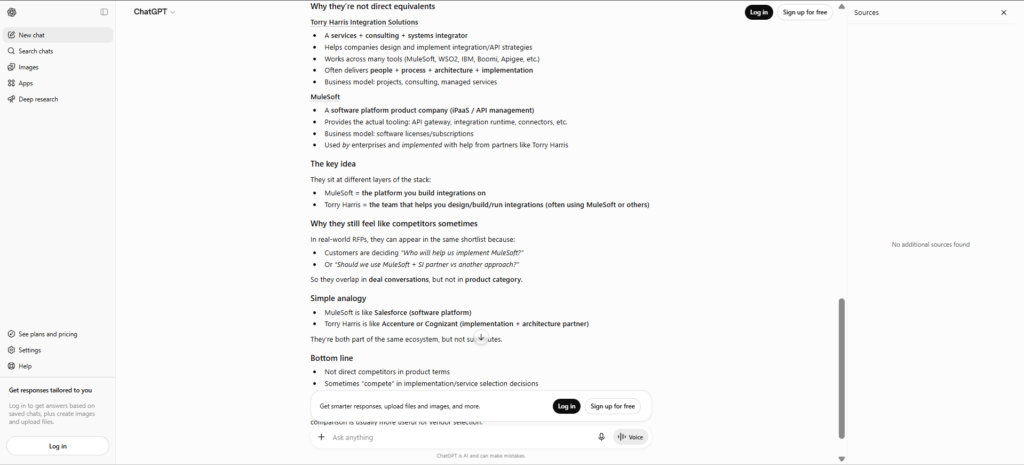
So the contradiction isn’t that AI changes its mind. It’s that different prompts activate different parts of Torry Harris’s digital footprint. One prompt frames the company as a software platform. Another frames it as a systems integrator. Both interpretations are individually defensible—but because the signals behind them aren’t clearly separated, AI switches between them depending on the question.
The next question, then, isn’t whether AI is wrong. It’s why those competing signals exist in the first place.
Deconstructing the Source: The Gartner Effect
This whiplash isn’t an AI bug. It’s a reflection of the signals available across the web.
As we traced the citations used by ChatGPT and Gemini, one ecosystem surfaced repeatedly: Gartner. Across both Gartner analyst pages and Gartner Peer Insights, Torry Harris appears in multiple contexts that reinforce different aspects of its business.
Gartner Peer Insights positions Torry Harris Integration Solutions alongside enterprise API management and integration vendors, providing structured competitor relationships for the broader company.
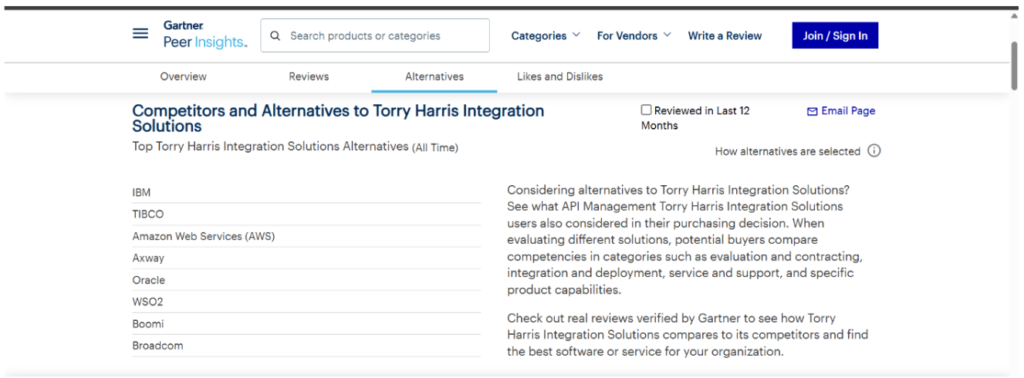
Separately, Gartner Peer Insights also maintains a dedicated listing for Torry Harris API Manager, where the product is evaluated alongside platforms such as Amazon API Gateway, Postman, and Google Apigee.
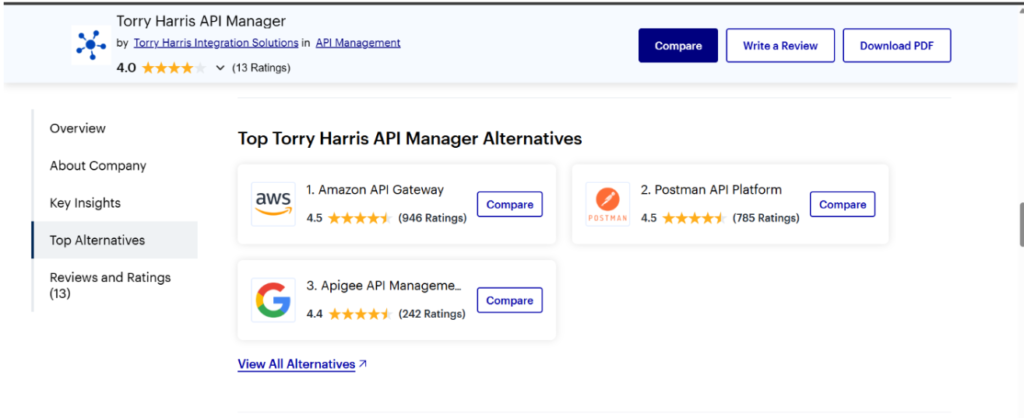
These structured analyst and review signals naturally position Torry Harris within the enterprise API platform ecosystem.
The comparison prompts, however, activate a much broader set of signals.
| Prompt type | Signal it activates | Resulting classification |
| Competitor Discovery | Gartner, Gartner Peer Insights, product directories, structured review ecosystems | Enterprise API platform vendor |
| Direct Comparison | Company website, services pages, analyst profiles, press coverage, partner ecosystem, broader web footprint | IT consulting / systems integrator—a partner, not a rival |
When a buyer asks who competes with Torry Harris, the prompt leans more heavily on structured analyst and review ecosystems, where both Torry Harris Integration Solutions and its API Manager product are positioned alongside enterprise API platform vendors. As a result, AI naturally returns companies such as MuleSoft, WSO2, Boomi, IBM, and Oracle as competitors.
When that same buyer asks for a direct comparison—for example, “Torry Harris or MuleSoft?”—the engines weigh the company’s broader digital footprint. Across its website, partner ecosystem, company profiles, press coverage, and editorial mentions, Torry Harris is predominantly presented as a systems integration and consulting firm. That much larger body of evidence shifts the comparison from platform versus platform to services versus platform, causing AI to reframe the relationship.
Neither answer is inherently wrong. Each is supported by legitimate signals from the web.
The challenge is that different prompts activate different signal clusters. One frames Torry Harris primarily as an enterprise API platform vendor; the other frames it as a systems integration and consulting firm. A buyer following a natural evaluation journey—discover competitors, compare alternatives, then build a shortlist—encounters both narratives. That inconsistency creates unnecessary friction and reduces confidence in the evaluation process.
What the AI Overview Confirms
Google’s AI Overview reinforces the same split. For branded queries, it describes Torry Harris accurately—API management, digital marketplaces, cloud and data transformation, AI and automation—and correctly identifies the target market (mid-to-large enterprises across telecom, banking, and government).
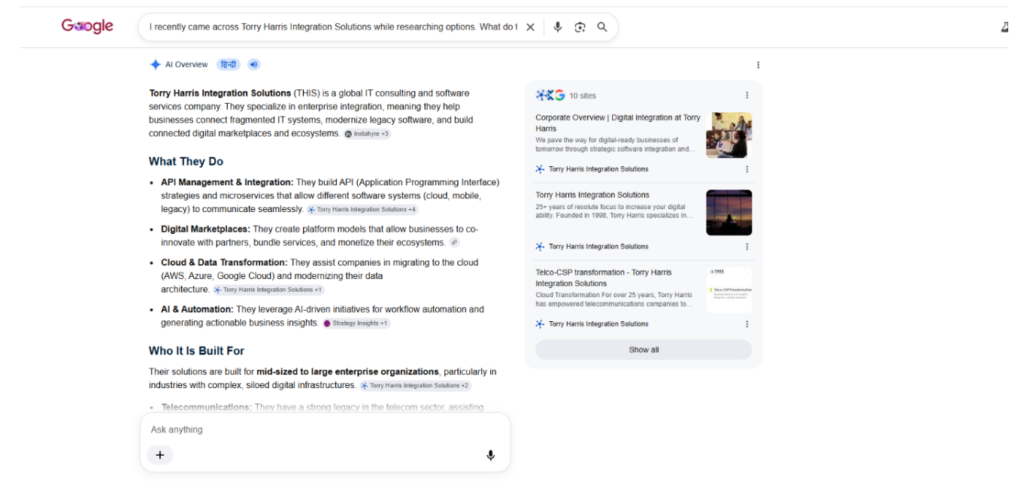
For the category query (“best Enterprise API Management & Integration Services”), Torry Harris Integration Solutions doesn’t appear at all—the Overview lists platform vendors instead.
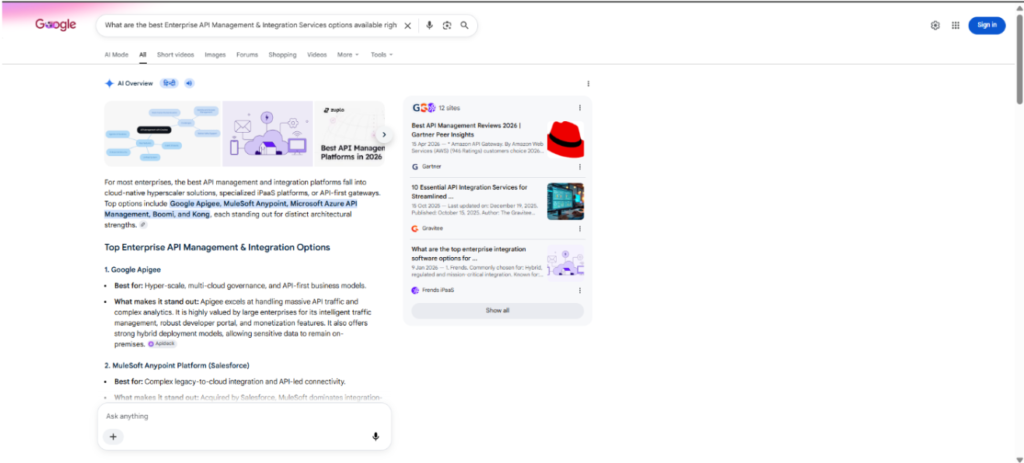
Recognized when named. Invisible—or reclassified—when the buyer asks the open question.
What This Reveals
Torry Harris’s gap isn’t missing signals. It’s conflicting ones. And that changes what the fix looks like.
Conflicting signals are harder to resolve than missing ones. When signals are missing, the path is simple: build them. When they conflict, building more content doesn’t help if it sends the same mixed message. The work is structural—separating the two identities so each is unambiguous—not just adding volume.
Companies that run both a product and a service hit this structurally. Torry Harris has a real API Manager product and a real systems-integration practice. Both are legitimate—and the answer isn’t to drop one. The issue is that AI can only hold one frame per query, so when the web blurs the two together, the engine guesses which applies and guesses inconsistently. Resolve it by making the two identities distinct and well-signposted, so AI can tell which one a given query is about.
The buyer impact is concrete. A prospect asks “who competes with Torry Harris?” and sees MuleSoft. They then ask “Torry Harris or MuleSoft?” and AI says the two aren’t comparable—one’s a platform, one’s a services firm. That’s not a subtle inconsistency; it’s a contradiction that makes a buyer question whether they understand the company at all.
The Priority Fixes
1. Make the dual identity explicit and structured—don’t collapse it into one.
The instinct here might be to “pick a lane,” but that’s the wrong fix: Torry Harris genuinely is both a services firm and a product vendor, and so are plenty of successful enterprises (IBM, Oracle, and SAP all run platforms and services arms). The problem isn’t that the company has two identities—it’s that the web presents them as an undifferentiated blur, so AI has to guess which one applies and guesses inconsistently.
The fix is to help AI hold both clearly, with context for when each applies. That means giving the product (the API Manager) and the services practice their own distinct, well-structured spaces: separate pages, separate schema (SoftwareApplication for the product, Organization/Service for the practice), separate comparison content (“Torry Harris API Manager vs. MuleSoft” for the product; “when to engage Torry Harris as your integration partner” for the services side).
When the two identities are explicitly delineated rather than merged, AI can route a competitor query to the product and a services query to the practice—instead of flip-flopping. The goal is clarity about which Torry Harris a buyer is dealing with in a given context, not abandoning either one.
2. Build an independent community and editorial presence.
Beyond Gartner and G2, third-party discussion of Torry Harris is thin—little in the way of forums, community threads, or industry press. Analyst authority exists, but the editorial and community layer that gives AI the confidence to recommend is underbuilt. With few independent sources to weigh, AI defaults to whichever signal is loudest—currently the services narrative. Targeted editorial and comparison coverage around the chosen positioning gives the engines a stronger, more consistent signal.
3. Tighten the technical foundations.
Add a robots.txt with explicit AI crawler directives and a sitemap reference. Collapse the redirect chain to a single hop. Fix the schema validation errors and incomplete markup. Set a single, stable, optimized homepage H1, and rewrite key title tags and meta descriptions. None of these is fatal on its own—the site works and AI can reach it—but together they sharpen the signals AI reads on every page.
The order matters: (1) separating and clarifying the two identities is what actually moves visibility; (2) the editorial work reinforces each one; (3) the technical fixes clean the base it all sits on.
See the full audit in action
The article below focuses on the key findings, but if you’d like to review the complete scorecard, prompt analysis, and recommendations, we’ve embedded the full report and a video breakdown of the audit.
- Audit Walkthrough Video
- Full Audit Report
About This Series
This is the fourth entry in our AI Visibility Mini Audit Series—complimentary, published audits for brands who request one. Each is a snapshot: the foundational, high-signal checks plus a multi-prompt visibility run, with deeper probes where the standard prompts point. The full engagement scores every check across a complete framework, tracks per-platform citation trends monthly, and ties findings to a 30/60/90 roadmap.
Want one? Drop your website and two competitors on our Reddit thread.