

A European women’s health brand serving 15+ countries, with 663 Trustpilot reviews, press coverage, and dedicated AI discovery files—yet absent from AI recommendations even in one of its strongest markets.
Audit At-a-Glance
| Brand | Fembites (fembites.com) |
| Category | Women’s Health Supplements |
| Market | European Union (15+ countries), with Germany as a primary market |
| Competitors Tested | Alex&eve, Sunday Natural, HER ONE |
| Platforms Tested | ChatGPT, Google Gemini |
| Prompts Run | 15 per engine (30 total) |
| Date Conducted | 6 May 2026 |
| Key Finding | Fembites has done more than most brands to prepare for AI discovery—including dedicated llms.txt and agents.md files. AI knows who Fembites is. But when buyers ask for women’s health supplements, even specifically in Germany, Fembites doesn’t appear. The validation is real; the editorial layer that feeds AI recommendations in this category and market is what’s missing. |
| Headline | Strong SEO and AI foundations, but limited category-level visibility is preventing AI discovery beyond branded searches across Europe. |
Why This Audit Exists
We opened a thread on Reddit with a simple offer: drop your website, and we’ll run a complimentary mini audit showing how AI platforms actually see your brand—then publish the findings.
It isn’t a sales pitch. It’s a public, replicable record of how brands perform in AI search, and what separates the brands AI recommends from the brands it merely recognizes.
Fembites is the second brand we’ve audited in this series. It introduces a new dimension: a multilingual European brand already serving customers across 15+ countries. That changes what AI visibility means—and where the gaps form.
See the full audit in action
The article below focuses on the key findings, but if you’d like to review the complete scorecard, prompt analysis, and recommendations, we’ve embedded the full report and a video breakdown of the audit.
- Audit Walkthrough Video
- Full Audit Report
Table of Contents
The Distinction That Drives This Audit
One idea does all the work here: readiness is not visibility.
Most SEO audits measure whether a site is built correctly—crawlable, indexed, structured, fast. That’s the input: whether AI can find and parse you.
It says nothing about the output: whether AI actually recommends you when a buyer asks.
So this audit measures both:
The inputs — can AI find and understand you? (Readiness)
- SEO Health reads every technical, on-page, and off-page foundation check.
- AI Readiness reads only the checks that affect AI specifically—crawler access, content structure, schema, third-party mentions.
The output — does AI actually recommend you? (Visibility)
- AI Visibility is measured empirically: real prompts on real engines, recording what they say. Not predicted. Measured.
Fembites scores well on both inputs. What makes this audit different from the previous two is why the output still falls short—and the answer is about the type of validation Fembites has earned and the editorial ecosystem AI draws on for category recommendations.
The Experiment
Methodology
We ran 15 prompts on each of two engines—ChatGPT and Google Gemini—in fresh, logged-out sessions to remove personalization bias.
The 15 prompts were split into three deliberate groups:
- Brand Identity (5 prompts) — Does AI know who Fembites is when asked directly?
- Category Recommendation (5 prompts) — When a buyer asks for the best women’s health supplements without naming Fembites, does the brand appear?
- Direct Comparison (5 prompts) — Pitted against Alex&eve, Sunday Natural, and HER ONE by name, how does AI position Fembites?
Each response was scored Y (named clearly), P (partial/indirect), or N (not mentioned).
The localization test
Fembites already serves customers across more than 15 European countries, including Germany, Austria, Switzerland, France, Italy, the Netherlands, Belgium, Poland, Sweden, and Spain.
Our initial category prompts were market-neutral: “What are the best women’s health supplement brands?”
When those returned nothing, we narrowed the query to Germany. The logic was simple: if AI didn’t surface Fembites globally, perhaps it would recognize the brand within one of its strongest markets.
It didn’t. And that’s what makes this finding significant.
The issue isn’t that Fembites lacks visibility in a single country. It’s that a brand already operating across much of Europe failed to appear even when AI was asked about a market where it already has customers, reviews, press coverage, and established operations.
The Results
Readiness (the inputs)
| Lens | Score | Read |
| SEO Health | 83 / 100 | Solid SEO foundations |
| AI Readiness | 83 / 100 | Strong AI-readiness foundations |
Fembites is technically well-built. AI crawlers are permitted. The site is server-rendered via Shopify, mobile-friendly, properly canonicalized, with clean URL architecture and a comprehensive sitemap covering products, collections, blogs, studies, and expert content.
Notably, Fembites has gone further than most brands: it publishes dedicated AI discovery files—llms.txt and agents.md—specifically designed to help AI systems find and understand the brand. This is genuinely ahead-of-curve for AI readiness.
Visibility (the output)
| Metric | Score | Read |
| AI Visibility | 63 / 100 | Recognized, but not yet recommended |
| Engine | Score (of 15) |
| ChatGPT | 9.5 |
| Gemini | 10 |
63 is a respectable score—above where most brands land. But the distribution of those points reveals the same pattern we’ve seen before, with a new wrinkle.
What the Prompts Revealed
Identity is strong
Every brand-identity prompt scored Y on both engines—the only exception being a partial (P) on ChatGPT for one comparison question. Asked who Fembites is, what they’re known for, what reviewers say, how pricing works, and who they’re best for, both engines answered accurately and in detail. No disambiguation needed—”Fembites” resolves cleanly to the right company.
AI knows this brand. It can describe the products, the positioning, and the customer base with confidence.
Category recommendation: invisible globally AND locally
Here’s where the localization test matters.
First pass—no location qualifier: We asked: “What are the best women’s health supplement brands?” and similar variations. Fembites scored N on both engines across all five prompts. Competing against global consumer-health brands in an open category query is difficult, even for a brand with strong regional presence.
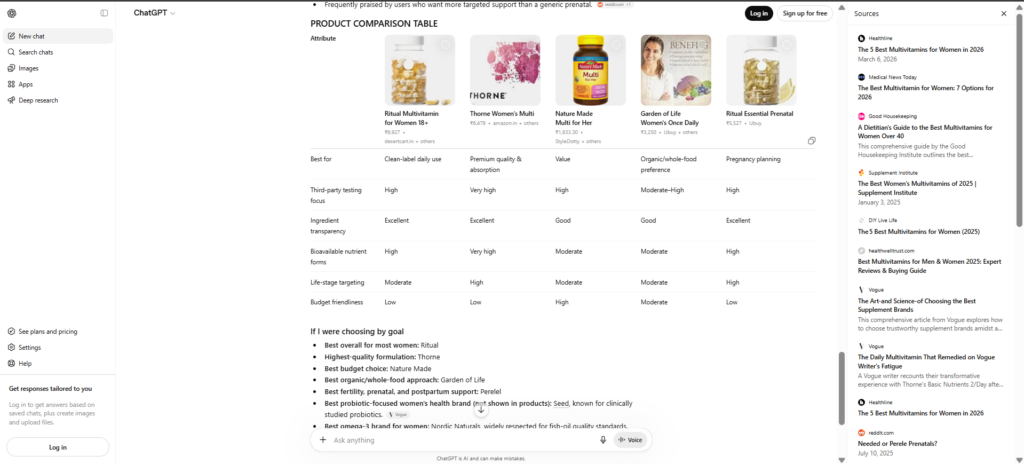
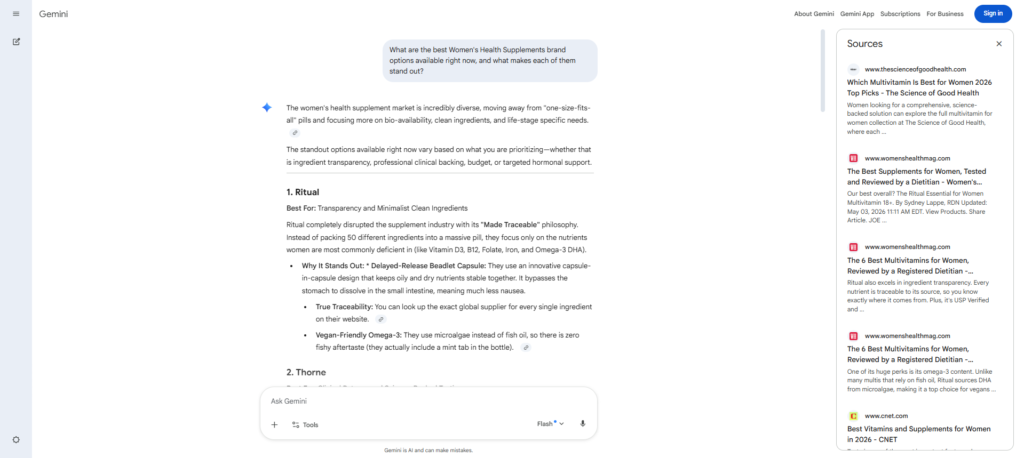
Second pass—Germany added: We then ran every category prompt with “in Germany” appended: “What are the best women’s health supplement brands in Germany?”
Fembites still scored N on both engines across all five prompts.
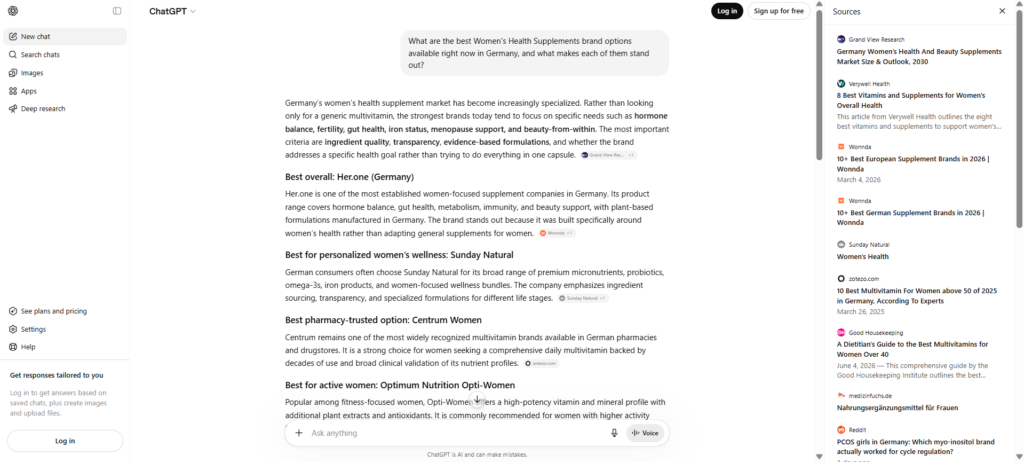
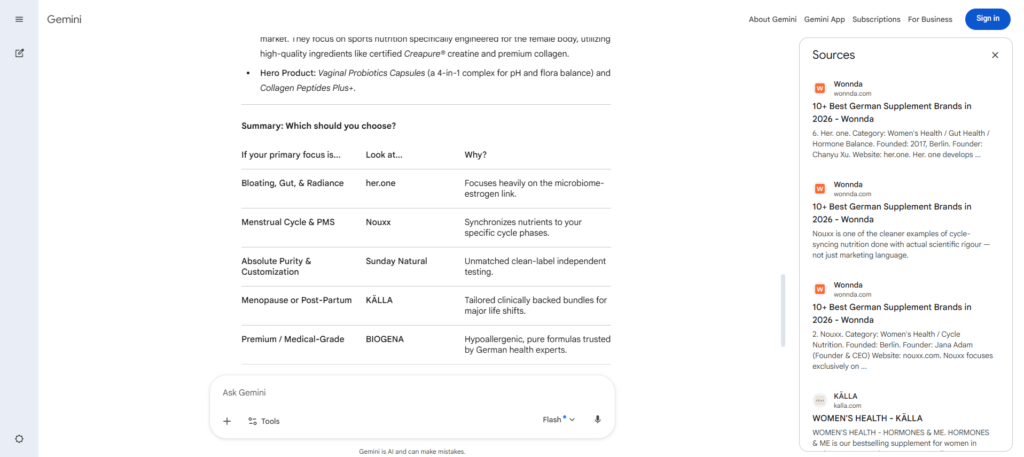
This is the finding that sets this audit apart. Fembites isn’t just invisible globally—it’s invisible in AI recommendations for its own primary market. A brand serving customers across more than 15 European countries doesn’t appear when AI is asked for women’s health supplement recommendations, even when the query is narrowed to one of its strongest markets.
That’s a visibility problem, not a market-size problem.
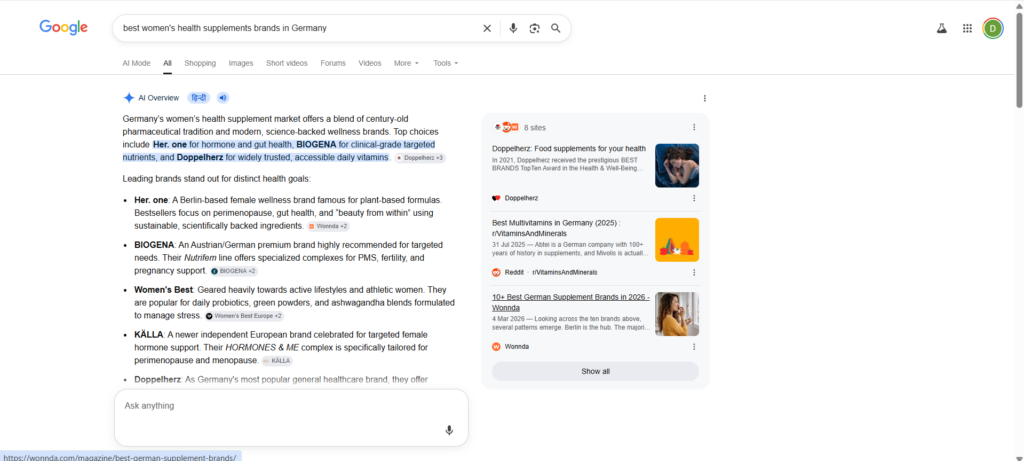
Google’s own AI Overview mirrors the pattern: Fembites appears prominently for branded queries (accurate brand, product, and founder information), but was not surfaced for “best women’s health supplements brands in Germany.”
Comparisons hold up well
Comparison prompts—Fembites vs Alex&eve, Sunday Natural, HER ONE—mostly returned Y on both engines, with all verdicts landing as ties. This is standard AI behavior: when given two named competitors, it compares rather than picks. The relevant signal is that AI can describe Fembites competently in a head-to-head—it’s the unprompted discovery that’s missing.
Why the Gap Exists
Fembites has more of the right signals than most brands at this stage:
- 663 Trustpilot reviews — substantial consumer validation
- Press and business platform coverage — referenced on Crunchbase, CB Insights, PitchBook, Gründer.de, and OpenPR
- Editorial backlinks — from established sites including Wunderweib and Trackle
- Backlink profile — approximately 510 referring domains and 10K backlinks
- AI-specific readiness — dedicated llms.txt and agents.md files
By the standards that sink most brands, Fembites has done the work. That’s what makes this case interesting. The issue isn’t a lack of technical readiness or trust signals—it’s the type and location of those signals.
1. Press releases and business platforms don’t feed recommendations
Fembites has third-party presence—but look at where: OpenPR (press releases), Crunchbase, CB Insights, PitchBook (investor/business platforms), and Gründer.de (startup coverage). These are legitimate mentions. They prove the brand is real and backed. But they’re not where AI looks when a buyer asks “What are the best women’s health supplements?”
AI builds recommendation lists from the same sources consumers read: editorial roundups (“best women’s health supplements in Germany”), product comparison articles, expert recommendation guides, and health/wellness publication coverage. The validation Fembites has earned is aimed at investors and business audiences; the validation it needs is aimed at buyers. These are different editorial ecosystems, and presence in one doesn’t transfer to the other.
2. Reviews validate but don’t recommend
663 Trustpilot reviews is substantial consumer proof. But review platforms tell AI that a brand is credible—they don’t tell AI the brand belongs on a recommendation shortlist. AI uses reviews to confirm and qualify; it uses editorial and comparison content to populate the list in the first place. The reviews will strengthen AI’s confidence once Fembites appears in recommendations—but they can’t get it onto the list alone.
3. The editorial comparison layer is thin
Whether that’s because the category has limited editorial coverage or because Fembites hasn’t yet earned enough inclusion, the outcome is the same: AI has relatively little comparison content to draw from when building recommendation lists. In categories where editorial coverage is limited, brands that secure roundup mentions, comparison placements, and expert recommendations often gain an outsized visibility advantage.
4. The heading hierarchy weakens page clarity
One technical issue compounds the content signal problem. The homepage H1 is assigned to FAQ content rather than the primary brand proposition—so when AI parses the most important page, the strongest structural signal points to “Frequently Asked Questions” rather than what Fembites actually is and does.
Several product pages carry multiple H1 tags (e.g., “Hormone Balance Bundle” alongside “Benefits” and “Ingredients” as separate H1s). This dilutes the topical clarity that helps AI understand what each page is primarily about.
Unlike the other findings, this one is directly fixable and worth addressing first.
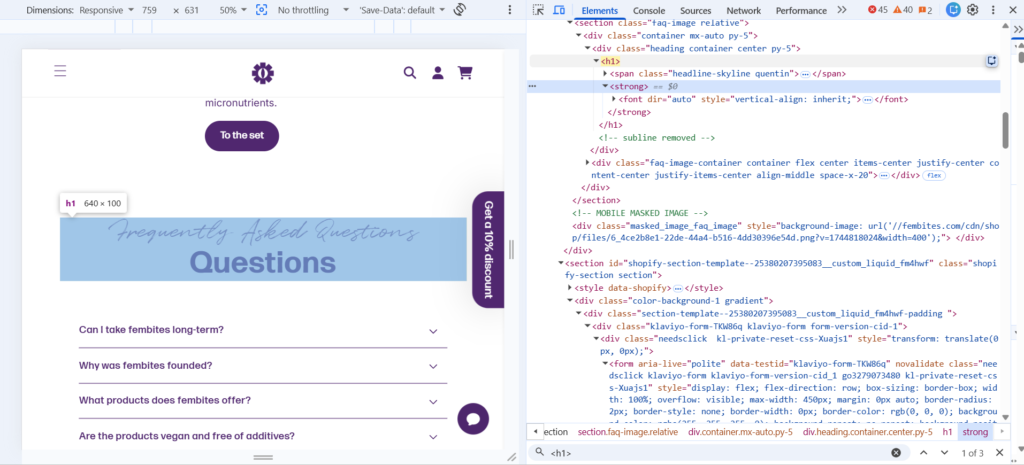
Not every issue is off-site. While the largest visibility gap is editorial, the audit also uncovered several structural SEO issues that affect how search engines and AI systems interpret the site.
The SEO Issues: Structural, Not Cosmetic
Unlike the previous audits where technical issues were purely minor, Fembites has few structural issues that directly affects how AI reads the site:
- Homepage H1 on FAQ content — The primary page’s strongest heading signal points to supplementary content rather than the core brand proposition. This is the first thing to fix.
- Multiple H1 tags on product pages — Weakens topical clarity for each product page. AI and search engines use H1 as the primary signal for “what this page is about.”
- German metadata on English pages — Creates a language mismatch that undermines international discoverability.
- Mobile LCP exceeding threshold — Homepage at 3.1s and study pages at 3.0s exceed Google’s 2.5s recommendation. Not critical, but worth optimizing.
- Image filename optimization — Largely auto-generated filenames and generic alt text miss opportunities for descriptive, keyword-relevant image metadata.
The heading hierarchy is the priority. The metadata localization is second. Everything else is incremental.
The Multi-Market Visibility Opportunity
Fembites faces a challenge the previous audits didn’t: it operates across multiple European markets, languages, and search ecosystems simultaneously. Visibility earned in Germany doesn’t automatically translate to visibility in English-language AI recommendations—and vice versa.
This is where AI visibility becomes more complex than traditional SEO. A brand can build authority in one market yet remain largely invisible in another because AI systems rely heavily on the language, publications, communities, and editorial sources associated with a specific audience.
The opportunity is significant. Fembites already has a strong foundation of trust signals, customer reviews, and market presence. The next step is earning visibility within the editorial ecosystems that influence recommendation queries across Europe. That means securing mentions in health publications, comparison articles, expert roundups, and community discussions in the markets where the brand wants to be discovered.
Each market needs its own editorial presence. AI recommendation systems don’t assume authority transfers across countries, languages, or audiences. Visibility must be earned within the ecosystem where the recommendation is being made.
The Priority Fixes
1. Build category-level editorial authority
Fembites has already earned trust signals, reviews, and business validation. What’s missing is presence in the editorial ecosystem AI relies on for recommendations. Prioritize inclusion in women’s health supplement roundups, comparison articles, expert recommendations, and wellness publications across key European markets. AI already knows the brand exists; it needs stronger evidence that the brand belongs on recommendation shortlists.
2. Strengthen visibility across language and market ecosystems
Fembites operates across multiple European markets, but visibility doesn’t automatically transfer between countries or languages. Localize metadata on English-language pages and build editorial presence in both German and English markets. AI recommendations are heavily influenced by the language and market context of the query, so each market needs its own authority signals.
3. Fix the structural SEO issues
The homepage H1 hierarchy, multiple H1s on product pages, metadata mismatches, and performance issues are all worth addressing. These won’t solve the recommendation gap on their own, but they help search engines and AI systems better understand the site and reinforce the visibility gains earned through stronger editorial authority.
The order matters: establish category authority first, expand that authority across key language and market ecosystems, and then reinforce it with technical improvements that strengthen AI understanding. Technical SEO creates the foundation; editorial authority is what drives recommendation visibility.
Access the Full Audit
This article highlights the key findings, but the complete audit includes the full scoring framework, prompt-by-prompt analysis, platform observations, and detailed recommendations.
- Audit Walkthrough Video
- Full Audit Report
About This Series
This is the third entry in our AI SEO Mini Audit Series—complimentary, published audits for brands who request one. Each mini audit is a snapshot: the foundational, high-signal checks plus a multi-prompt visibility run, with deeper probes where the standard prompts point. The full engagement scores every check across a complete framework, tracks per-platform citation trends monthly, and ties findings to a 30/60/90 roadmap.
Want one? Drop your website and two competitors on Reddit.