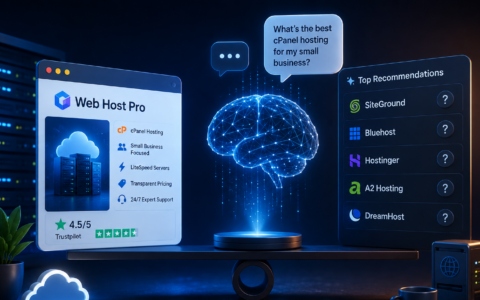

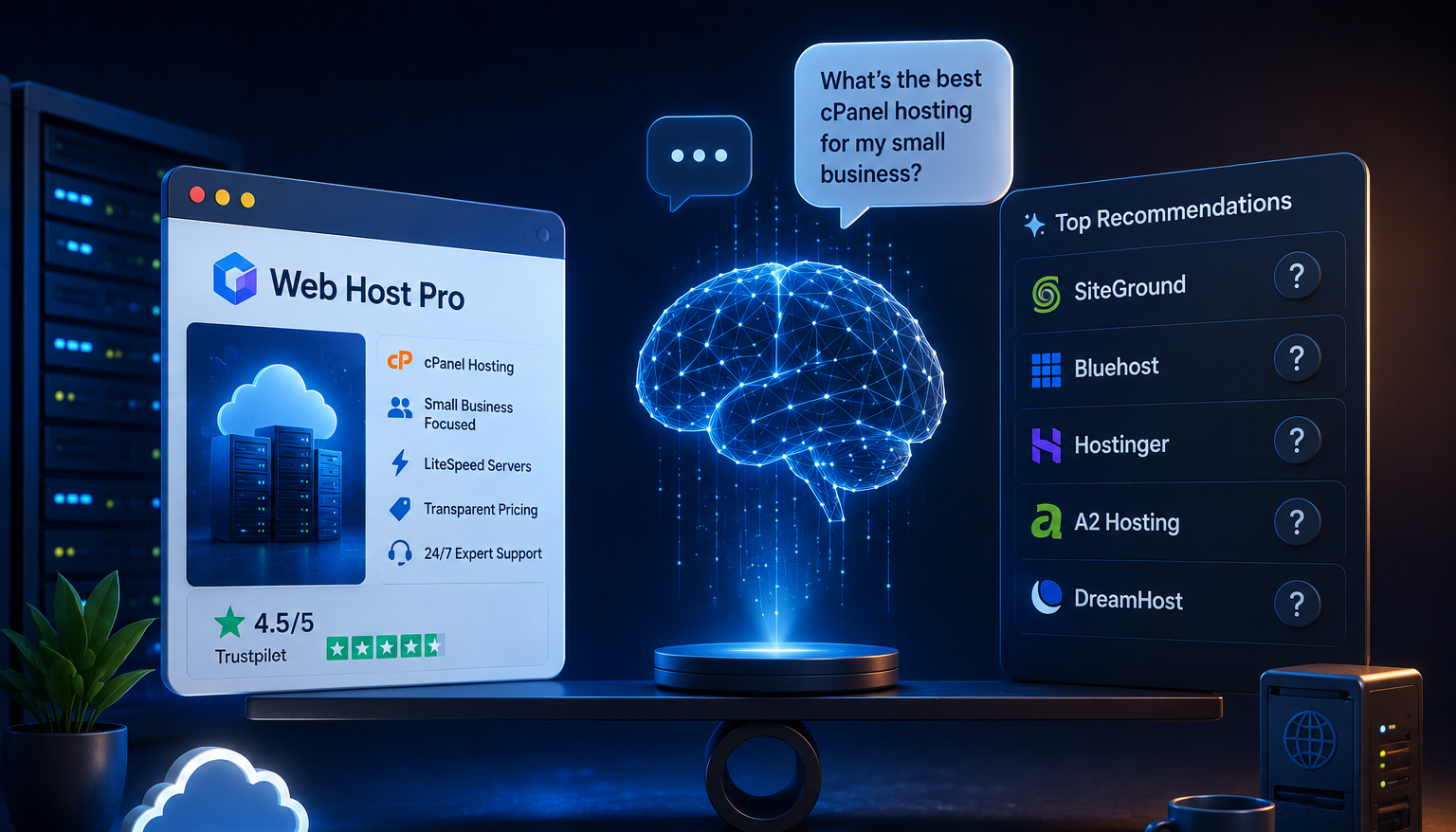

ChatGPT and Gemini correctly identify cPanel hosting and small-business hosting as Web Host Pro’s strengths—and then recommend Bluehost, HostGator, and A2 Hosting for those exact queries
Audit At-a-Glance
| Brand | Web Host Pro (webhostpro.com) |
| Category | Web Hosting |
| Competitors Tested | Bluehost, Hostgator |
| Platforms Tested | ChatGPT, Google Gemini |
| Prompts Run | 15 per engine (30 total) + targeted niche probes |
| Date Conducted | 6 May 2026 |
| Key Finding | AI describes Web Host Pro’s strengths accurately—cPanel hosting and small-business fit—but when buyers search for those exact niches, AI recommends competitors instead. The validation exists; it isn’t in the places AI pulls from when building recommendations. |
| Headline | Strong SEO and AI-readiness foundations, but third-party validation isn’t positioned in the contexts that drive AI recommendations |
Why This Audit Exists
We opened a thread on Reddit with a simple offer: drop your website, and we’ll run a complimentary mini audit showing how AI platforms actually see your brand—then publish the findings.
It isn’t a sales pitch. It’s a public, replicable record of how real B2B brands perform in AI search, and what separates the brands AI recommends from the brands it merely recognizes.
Web Host Pro is the third brand we’ve audited, and it reinforces a pattern emerging across this series: being understood by AI is not the same as being recommended by it. AI can accurately describe Web Host Pro’s strengths and ideal customers. The challenge is converting that understanding into visibility when buyers ask for solutions.
See the full audit in action
The article below focuses on the key findings, but if you’d like to review the complete scorecard, prompt analysis, and recommendations, we’ve embedded the full report and a video breakdown of the audit.
- Audit Walkthrough Video
- Full Audit Report
Table of Contents
The Distinction That Drives This Audit
One idea does all the work here: readiness is not visibility.
Most SEO audits measure whether a site is built correctly—crawlable, indexed, structured, fast. That’s the input: whether AI can find and parse you.
It says nothing about the output: whether AI actually recommends you when a buyer asks.
So this audit measures both, on two tracks:
The inputs — can AI find and understand you? (Readiness)
- SEO Health reads every technical, on-page, and off-page foundation check.
- AI Readiness reads only the checks that affect AI specifically—crawler access, content structure, schema, third-party mentions.
The output — does AI actually recommend you? (Visibility)
- AI Visibility is measured empirically: real prompts on real engines, recording what they say. Not predicted. Measured.
Web Host Pro scores high on the inputs and respectably on the output. So this isn’t a story about something broken. It’s a story about where the existing visibility leaks—and that turned out to be more specific than we expected.
The Experiment
Methodology
We ran 15 prompts on each of two engines—ChatGPT and Google Gemini—in fresh, logged-out sessions to remove personalization bias.
The 15 prompts were split into three deliberate groups:
- Brand Identity (5 prompts) — Does AI know who Web Host Pro is when asked directly?
- Category Recommendation (5 prompts) — When a buyer asks for the best web hosting without naming Web Host Pro, does the brand appear?
- Direct Comparison (5 prompts) — Pitted against Bluehost and Hostgator by name, how does AI position Web Host Pro?
Each response was scored Y (named clearly), P (partial/indirect), or N (not mentioned).
We then ran an additional set of targeted probes—not part of the standard 15—on the specific niches AI itself surfaced as Web Host Pro’s strengths. That’s where the most useful finding came from.
The Results
Readiness (the inputs)
| Lens | Score | Read |
| SEO Health | 81 / 100 | Solid SEO foundations |
| AI Readiness | 89 / 100 | Strong AI-readiness foundations |
Technically, Web Host Pro is in excellent shape. Robots.txt allows all AI crawlers. The site is server-rendered, mobile-friendly, indexed across 388 URLs, and carries valid Organization schema with logo, founding date, contact details, and social profiles. AI can find, parse, and understand the brand without trouble.
Visibility (the output)
| Metric | Score | Read |
| AI Visibility | 61 / 100 | Recognized, but not yet recommended |
| Engine | Score (of 15) |
| ChatGPT | 10 |
| Gemini | 10 |
61 is a respectable output. But the shape of where those points come from—and where they don’t—is the real story.
What the Prompts Revealed
The prompts produced a clean pattern: strong identity, no category presence, and a deeper finding when we pushed past the standard prompts.
Identity is solved
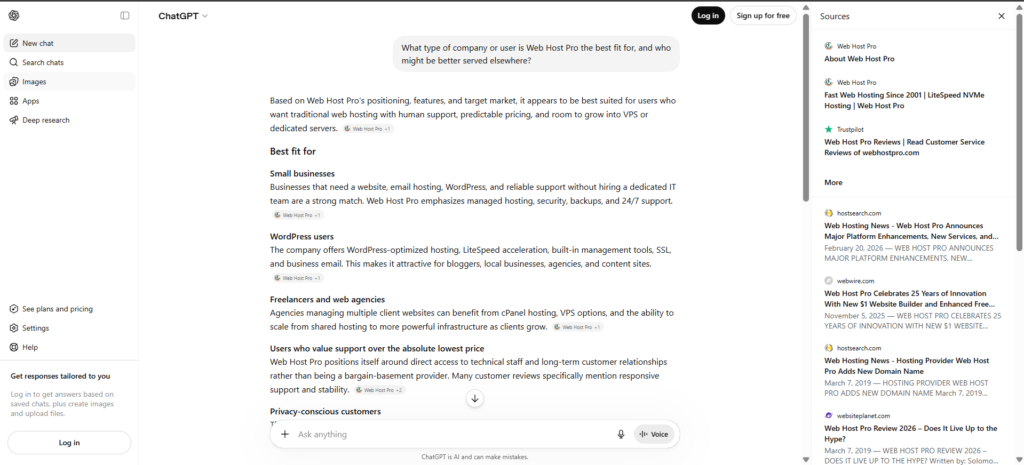
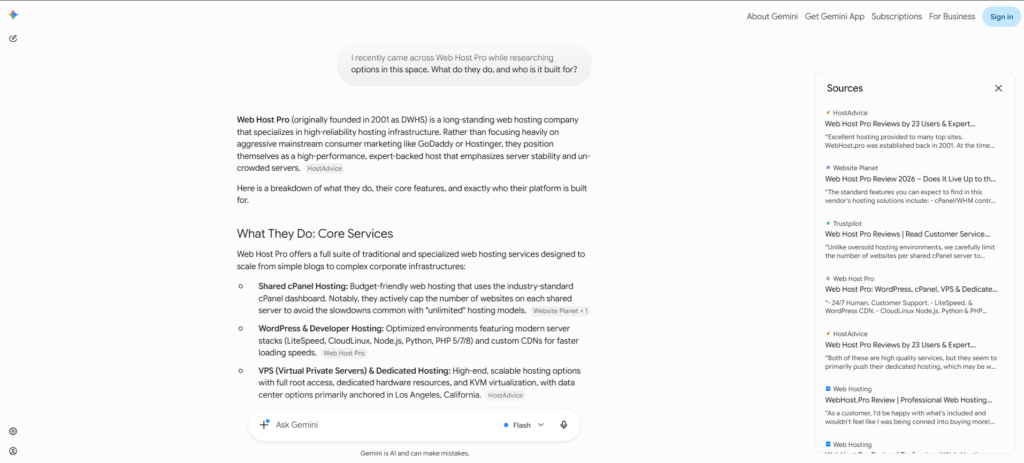
Every brand-identity prompt scored Y on both engines. Asked who Web Host Pro is, what it’s known for, what reviewers say, how pricing works, and who it’s best for, ChatGPT and Gemini answered accurately and confidently—no disambiguation required.
The engines also volunteered specifics. Across the identity responses, both ChatGPT and Gemini consistently named cPanel-based hosting and small-business hosting as Web Host Pro’s strengths. That’s useful information—and it set up the test that turned out to matter most.
Category recommendation is the wall
Across all five standard category prompts—”What are the best web hosting options?”, “Which providers would you recommend?”, “Who are the leading providers today?”—Web Host Pro scored N on both engines. Zero mentions, every time.
Google’s own AI Overview confirms the pattern: Web Host Pro appears in AI Overviews for branded, entity-based queries, but is absent from AI Overviews for broad commercial queries like “best web hosting for small businesses.” Recognized when named. Invisible when the buyer asks the open question that actually drives a purchase.
A zero on broad category prompts is more common than most brands realize. So we pushed deeper.
The deeper test: even Web Host Pro’s claimed strengths don’t break through
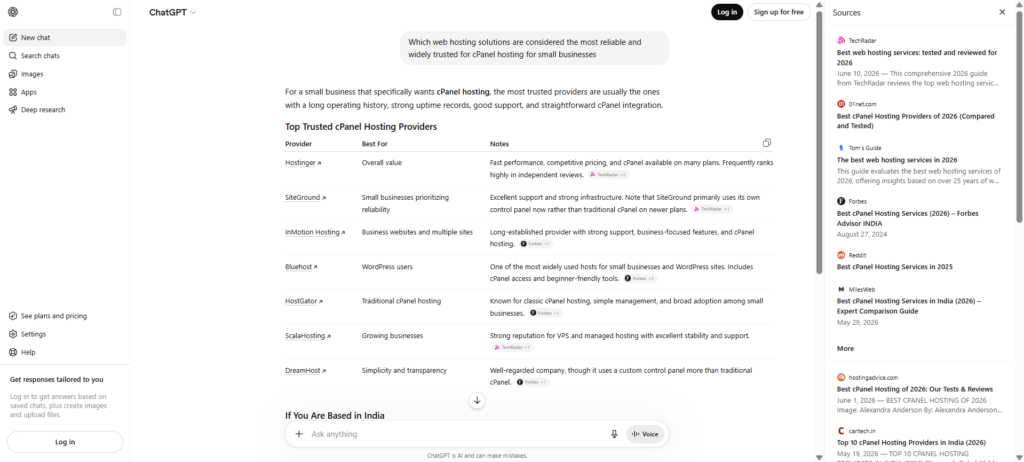
Since the identity prompts had given us two clear strengths AI itself recognized—cPanel hosting and small-business hosting—we ran a targeted query combining both: “Which web hosting solutions are considered the most reliable and widely trusted for cPanel hosting for small businesses?”
This isn’t a generic “best web hosting” question. It’s the precise buyer search Web Host Pro should win, if anyone should. The brand has the positioning, the product fit, and the recognition.
ChatGPT’s response listed: Bluehost, HostGator, InMotion Hosting, A2 Hosting, DreamHost, Hostinger, KnownHost, ChemiCloud, and Liquid Web.
Gemini’s response listed: Bluehost, InMotion, A2 Hosting, and Namecheap.
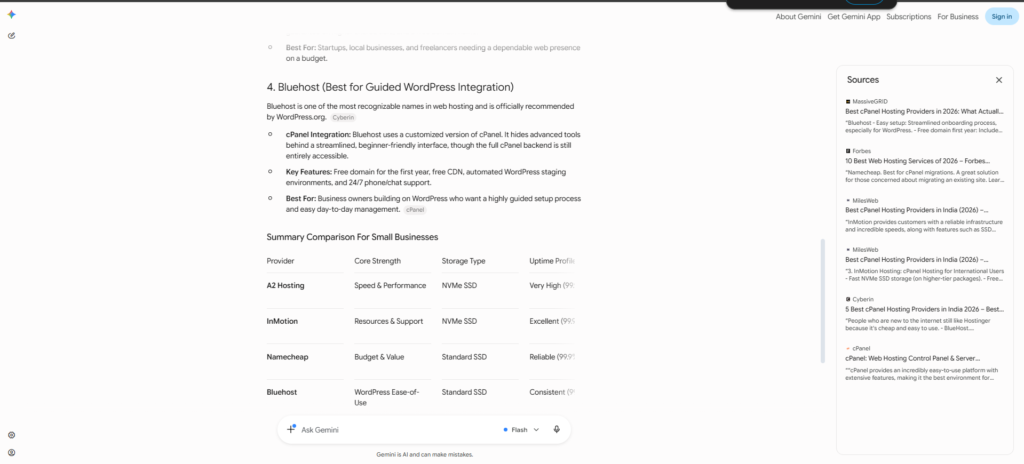
Web Host Pro appeared in neither.
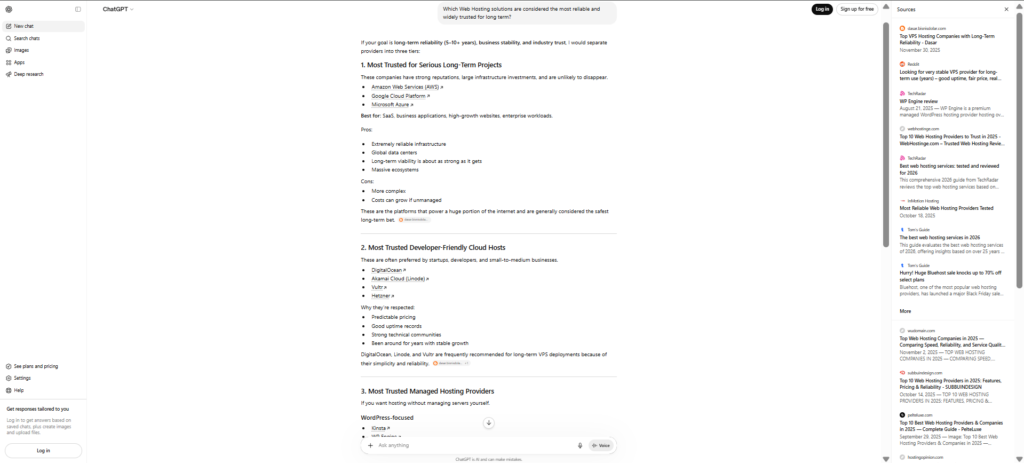
We then added “for long term” to the same query, thinking a longer-horizon question might surface a brand known for pricing transparency and stable renewals.
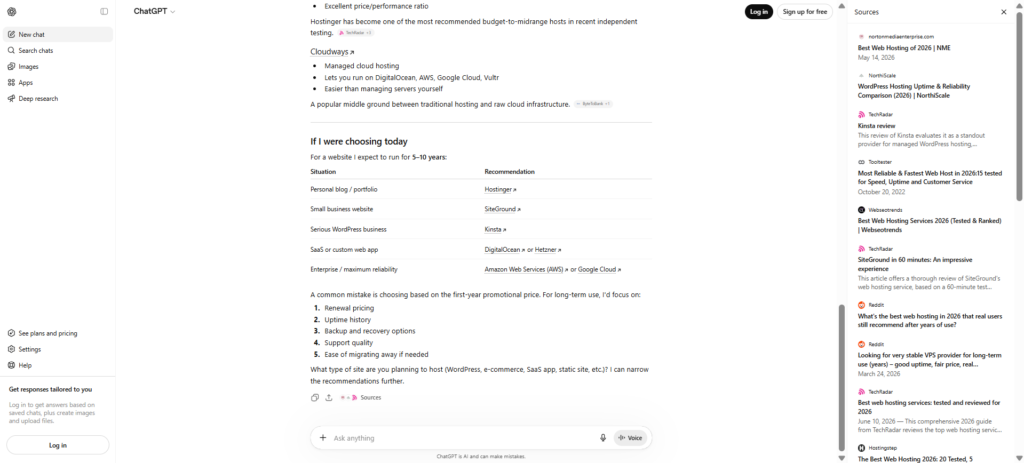
ChatGPT’s updated response listed: Hostinger, SiteGround, Kinsta, DigitalOcean, Hetzener, AWS, Google Cloud, Microsoft Azure, Kinsta, WP Engine, Site Ground, InMotion, Bluehost, HostGator, and Namecheap. Even in a response that covered broad hosting platforms, ChatGPT still didn’t surface Web Host Pro as the alternative.
Gemini’s updated response listed: Site Ground, Hostinger, WP Engine/Kinsta, Bluehost and DreamHost.
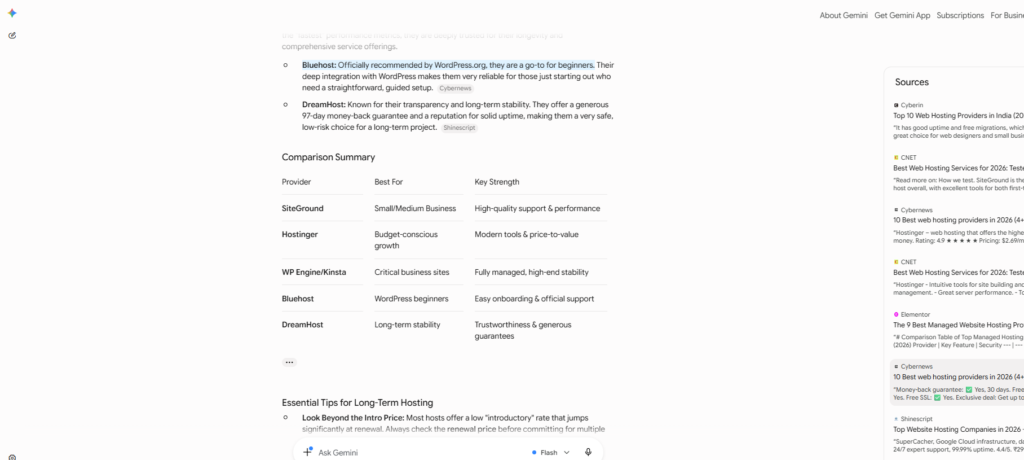
Web Host Pro appeared in none of these responses either.
That’s the finding that reframes everything else. AI isn’t unaware of Web Host Pro’s strengths—it described them accurately in the identity prompts. But when a buyer searches for those exact strengths, AI reaches for competitors instead. Every time. Across both engines. Even when the query is tailored to favor exactly what Web Host Pro offers.
Where AI pulls its answers from
The source panels in both engines reveal why Web Host Pro doesn’t appear. When ChatGPT builds its cPanel hosting recommendations, it cites: TechRadar, Forbes, Tom’s Guide, TechFault, Bluehost’s own site, and Reddit threads. When Gemini builds the same list, it cites: CyberNews, CNET, PCMag, gauravtiwari.org roundups, and editorial comparison articles from Slashdot.
These are the editorial contexts Web Host Pro is absent from. The brand has Trustpilot reviews and directory listings—but it doesn’t appear in the “best cPanel hosting” roundups, the “web hosting for small businesses” comparison articles, or the niche-specific editorial coverage that AI draws on when constructing a recommendation list.
Direct comparisons behaved as expected
Comparison prompts (“How does Web Host Pro compare to Bluehost?”) returned exactly what AI platforms typically produce: balanced, use-case-specific answers rather than declarations. ChatGPT went as far as building a recommendation table—Bluehost for WordPress sites and growing businesses, Web Host Pro for developers wanting LiteSpeed and cPanel with hands-on support. Gemini produced a similar side-by-side showing Web Host Pro as “The Independent Choice” and Bluehost as “The Corporate Giant.”
This is standard AI behavior: when given two named competitors, it compares rather than picks. Out of curiosity, we pushed both engines with a forced-choice follow-up: “Choose one.” Both picked Bluehost—citing its larger ecosystem, WordPress.org endorsement, and infrastructure scalability. We note it for completeness, but the forced-choice verdict is an artifact of an unnatural prompt, not the audit’s diagnosis. The diagnosis sits in the niche tests above.
Why the Gap Exists
The usual obstacles are already handled. Identity is clean—no namesake confusion, no need for a descriptor. Third-party validation is real: Trustpilot 4.5/5, HostAdvice, Serchen, Website Planet, Top10 hosting directories, independent discussion on Reddit, Quora, Hacker News, and WHMCS forums, and a healthy backlink profile (Domain Rating 64, ~921 referring domains, ~25K backlinks, no obvious spam).
By the standards that sink most brands, Web Host Pro has done the work.
What makes this case unusual is that AI already understands Web Host Pro. Both ChatGPT and Gemini independently identified cPanel hosting and small-business hosting as core strengths. This indicates that the brand’s website, content, and existing third-party signals are sufficient for AI systems to identify what the company does and who it serves.
However, understanding does not automatically lead to recommendation visibility. When AI platforms generate recommendations for queries such as “best cPanel hosting for small businesses,” they rely heavily on editorial roundups, comparison articles, expert reviews, and community discussions that explicitly associate brands with those use cases.
Web Host Pro already has strong trust signals, including reviews, directory listings, community mentions, and backlinks. But most of those signals validate the company as a credible hosting provider rather than associating it with specific recommendation categories. As a result, AI can accurately describe Web Host Pro, yet still recommend competitors when buyers search for cPanel hosting or small-business hosting solutions.
The distinction is important. Trust signals help AI determine whether a company is legitimate and trustworthy. Recommendation signals help AI determine whether a company belongs on a shortlist for a specific use case. Web Host Pro has largely earned the first type of signal. The second type remains limited.
This is a common plateau in AI visibility: recognized, reviewed, and credible—but absent from the editorial and comparison ecosystems that shape recommendation lists.
The SEO Issues: Individually Minor, Cumulatively Real
None of Web Host Pro’s technical issues is critical on its own. But several small leaks compound, and tightening them strengthens the same authority signals that feed visibility:
- Trailing-slash 404s — webhostpro.com/web-hosting/ returns a 404 instead of redirecting to the canonical /web-hosting. Clean canonicalization consolidates ranking signals instead of splitting them.
- WHMCS store URL duplication — store URLs like /index.php/store/web-hosting appear indexable with no canonical or noindex directive, risking duplicate versions of closely related hosting pages.
- Sitemap hygiene — the sitemap includes transactional URLs (cart/login) that shouldn’t be indexed, plus low-value archive pages diluting the crawl.
- Heading structure — the SEO Services page carries two H1s, the About page uses a non-descriptive “About.” H1, and the SSL page uses a grammatically awkward H1. Each is a missed relevance signal.
- Meta descriptions — a few (Dedicated Servers, SEO Services) exceed the recommended length and may truncate in results.
- Minor speed and links — TTFB around 830ms sits slightly above the ideal threshold, and three broken outbound links point to retired content.
Individually, footnotes. Together, signal leakage—and cleaning them up makes every page AI reads a little clearer and more authoritative. They won’t solve the recommendation gap on their own, but they strengthen the foundation on which visibility is built.
Recognition Isn’t Recommendation
Web Host Pro is one brand, but the pattern is increasingly common.
People increasingly use AI for detailed, context-rich questions rather than simple keyword searches. Instead of asking “best web hosting,” they ask: “What’s the most reliable cPanel hosting for my small business for the long term?” AI search naturally encourages buyers to describe their specific situation, constraints, and preferences—and AI responds with equally specific recommendations. This changes which signals matter.Broad category authority (“we’re a web hosting company”) is less valuable than niche authority tied to specific queries (“we’re the cPanel hosting choice for small businesses that want transparent pricing”).
AI describing your strengths is not the same as AI recommending you for them. When the engines explain who you are, they pull from your own content and a small set of trusted sources. When they recommend you for a niche, they pull from a different layer—editorial roundups, comparison articles, and niche community threads. Most brands assume the first layer feeds the second. It doesn’t, automatically.
General validation and niche recommendation draw from different sources. Trustpilot scores and directory listings confirm you exist and are credible. Editorial roundups on TechRadar, Forbes, PCMag, and niche comparison blogs are what make you the chosen option when AI builds a shortlist. These are two different content ecosystems, and presence in one doesn’t guarantee presence in the other.
The fastest gain isn’t more validation—it’s better-placed validation. Earning inclusion in five “best cPanel hosting” roundups or three “web hosting for small businesses” comparison articles will move AI visibility more than another fifty directory listings. Concentration in the right editorial contexts beats volume in general ones, once foundational credibility is in place.
The Priority Fixes
1. Earn presence in the editorial contexts AI reads for long-tail queries. People ask AI specific questions: “best cPanel hosting for small businesses,” “most reliable web hosting with transparent pricing,” “web hosting for developers who want LiteSpeed.” These are the queries Web Host Pro should win. Focus on earning inclusion in “best cPanel hosting” and “best web hosting for small businesses” roundups, comparison articles, expert reviews, and community discussions where these buying decisions are actively being shaped. Create and publish comparison content targeting these long-tail queries directly. The goal isn’t broad “web hosting” authority—it’s owning the specific niches AI already recognizes as your strengths.
2. Resolve indexation and duplication risk. Add canonical or noindex directives to WHMCS/store URLs and fix the trailing-slash 404s so signals consolidate onto single, authoritative pages.
3. Tighten sitemap and on-page hygiene. Remove transactional URLs from the sitemap, fix the multiple and weak H1s, and trim over-length meta descriptions. Small fixes that cumulatively sharpen relevance.
See the full audit in action
The article below focuses on the key findings, but if you’d like to review the complete scorecard, prompt analysis, and recommendations, we’ve embedded the full report and a video breakdown of the audit.
- Audit Walkthrough Video
- Full Audit Report
About This Series
This is the second entry in our AI SEO Mini Audit Series—complimentary, published audits for B2B brands who request one. Each mini audit is a snapshot: the foundational, high-signal checks plus a multi-prompt visibility run, with deeper probes where the standard prompts point. The full engagement scores every check across a complete framework, tracks per-platform citation trends monthly, and ties findings to a 30/60/90 roadmap built around the specific niches a brand can credibly own.
Want one? Drop your website and two competitors on our Reddit thread.