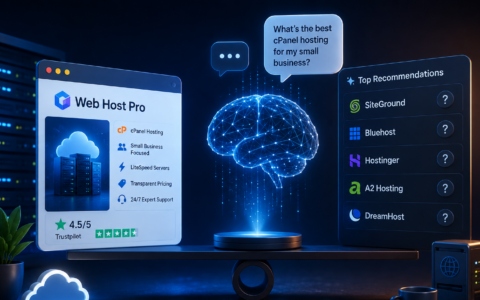



AI is sending you customers and your analytics is crediting Google. Here’s why, and a practical framework for measuring it.
At-a-Glance
| The problem | AI referrals rarely pass a referrer. Most AI-influenced buyers arrive through Google or direct, so the channel that created the demand gets none of the credit. |
| The wrong fix | Staring at your AI referral traffic number, seeing a trickle, and deciding AI search isn’t worth investing in. |
| The right fix | A four-layer measurement system where each layer answers a different question and only the top layer moves fast enough to steer by. |
| What you’ll need | GA4, Google Search Console, a form field, a spreadsheet. Paid tools help but aren’t the starting point. |
| Honest expectation | You will not get clean, deterministic attribution. You will get a defensible, directional case, which is what the channel actually supports. |
Why This Is Harder Than It Should Be
When someone finds you through Google, the plumbing works. There’s a referrer, a query in Search Console, a session in GA4, and a path you can trace to a signup.
AI search breaks nearly all of that:
- Most AI answers don’t produce a click. The model summarises, compares, and recommends. The buyer reads it, forms an opinion, and leaves—no session, no data, no trace. Your brand did work that nothing recorded.
- When there is a click, the referrer often goes missing. Some AI surfaces pass a clean referrer. Others don’t, and privacy-focused browsers strip what’s left. That traffic lands in your “Direct” bucket, indistinguishable from someone typing your URL.
- The buyer’s actual path launders the credit. They read about you in ChatGPT, then open Google and search your brand name because that’s the habit. Google takes the credit. This isn’t an edge case, it’s the norm. In one published case study, roughly four in five users who said they’d discovered a brand through AI had arrived via Google or direct.
- Even visibility tools can’t see everything. AI systems decompose a question into multiple sub-queries before retrieving anything—so the answer a buyer sees may be assembled from prompts nobody tracked. Independent testing of visibility tools has found significant undercounting against manual checks. They are useful directionally; not ground truth.
The honest starting position is this: AI search attribution is probabilistic, not deterministic. The goal isn’t certainty. It’s reducing uncertainty enough to make good budget decisions and being able to show your CFO the reasoning.
The Four Layers
The mistake almost everyone makes is measuring one layer and treating it as the whole picture. Each layer answers a different question, moves at a different speed, and has a different blind spot.
| Layer | Question it answers | Size of signal | Time Horizon |
|---|---|---|---|
| 1. Visibility | Do AI engines mention us at all? | Leading indicator | Weeks |
| 2. Direct AI referrals | Who clicked through from an AI answer? | Smallest slice | Immediate |
| 3. AI-influenced demand | Is AI creating branded demand elsewhere? | Largest slice | 1–2 quarters |
| 4. Self-reported → pipeline | Did any of it become revenue? | Ground truth | Full sales cycle |
Read that table twice. The layer with the biggest signal (Layer 3) is the hardest to attribute, and the layer that’s easiest to measure (Layer 2) is the smallest. That mismatch is why so many teams write off AI search after one quarter.
Layer 1 – Visibility: are you in the answer at all?
This is your leading indicator. It moves before traffic does, which makes it the only layer fast enough to actually steer by.
What to do:
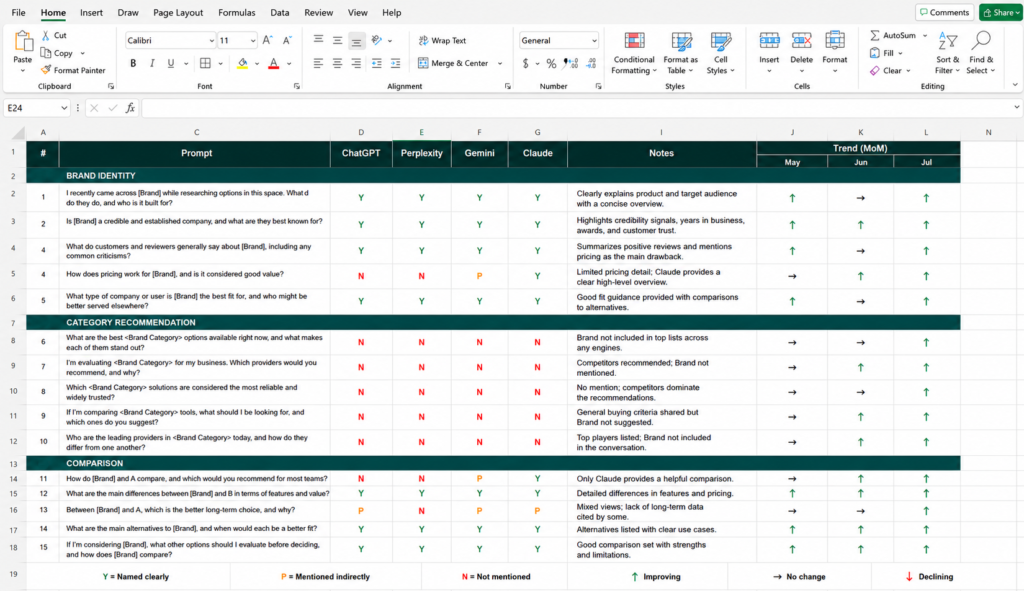
Build a fixed prompt set: 15 to 30 prompts covering the questions your buyers actually ask, split into three groups:
- Identity: “What is [brand]?” / “Is [brand] credible?”
- Category: “What are the best [category] tools?” / “Which [category] providers would you recommend?”
- Comparison: “How does [brand] compare to [competitor]?”
Run them on a fixed schedule, monthly is enough to start—in fresh, logged-out sessions so personalisation doesn’t flatter you. Score each response simply: named clearly (1), mentioned indirectly (0.5), or absent (0).
Log it in a spreadsheet with the date, engine, prompt, score, and a one-line note. That’s it. The discipline matters more than the tooling.
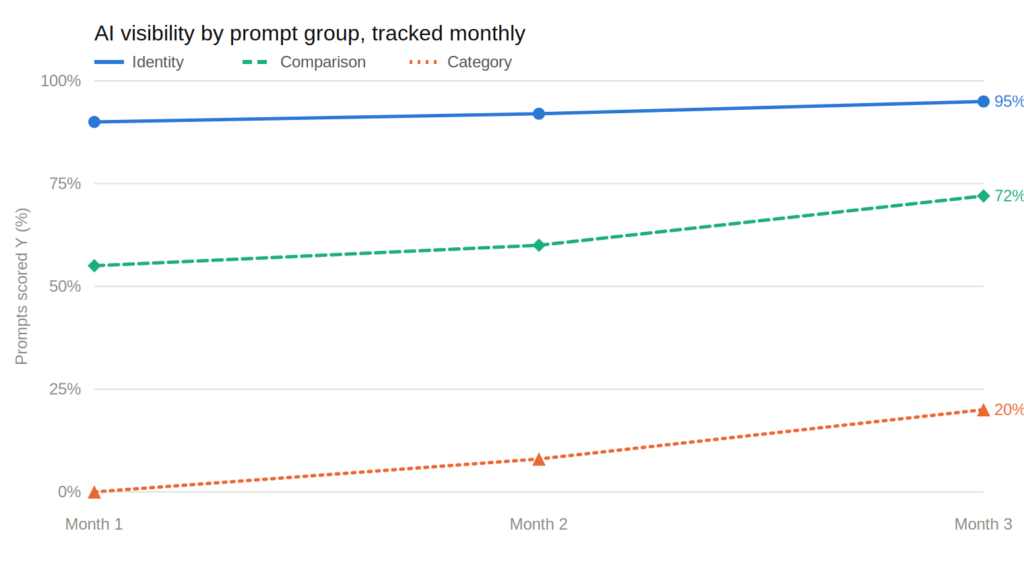
What it tells you: Whether the work is landing. If category mentions start appearing where there were none, something is changing—usually two to three months before traffic reflects it.
What it can’t tell you: Anything about revenue. Visibility is not value; it’s the precondition for it.
When to add a tool: Once you’re tracking more than about 30 prompts or several competitors, manual runs stop scaling. Paid platforms automate the sampling and add share-of-voice benchmarking. Just know what you’re buying, they run their prompt library against their schedule, which is why their numbers and your manual spot-checks won’t match. Neither is wrong. They’re measuring different things.
Google is also rolling out (starting mid-2026) a generative-AI performance view in Search Console that shows how often your pages appear in its AI Overviews and AI Mode. It is useful and free, but worth knowing its limits: it’s impressions-only for now (no clicks, no queries), it blends the AI surfaces together, and it only covers Google’s AI, not ChatGPT, Perplexity, or the others. In other words, it’s a partial Layer 1 feed, not the answer to the whole problem.
Layer 2 – Direct AI referrals: The small, visible slice
This is the number everyone looks at first and over-weights.
What to do:
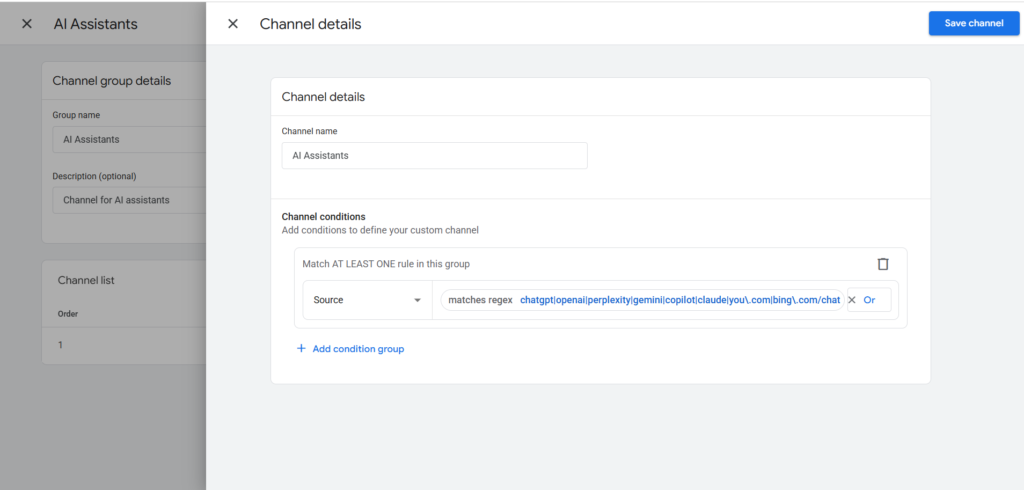
GA4 has started classifying recognised AI assistant traffic into its own channel, which makes the baseline easier than it used to be. But don’t rely on it alone — coverage of newer surfaces lags. Build your own segment as well.
Create a GA4 exploration with a session-source filter matching AI referrers (using the “matches regex” match type):
chatgpt|openai|perplexity|gemini|copilot|claude|you\.com|bing\.com/chatSave it as a custom channel group so it persists in your reports rather than living in one ad-hoc exploration.
Then look at behaviour, not just volume. AI-referred sessions usually behave differently: they show higher intent and a faster path to pricing and signup pages because the model already did the shortlisting. If your AI traffic converts at two or three times your organic rate, that’s the finding worth reporting, not the raw session count.
Add UTMs where you control the link. Anywhere you can influence how a URL is distributed—documentation, syndicated content, partner placements, or your own AI-facing assets—tag it. You won’t cover AI-generated citations, but every tagged URL is one less thing landing in Direct.
What it tells you: The floor. The minimum verified AI-driven traffic.
What it can’t tell you: The true size of the channel. This number is systematically understated, and reporting it as “our AI traffic” is how the channel gets killed in a budget meeting.
Layer 3 – AI-influenced demand: the big invisible one
Here’s the layer that actually carries the volume, and it’s inferred rather than tracked.
The logic chain is straightforward and defensible:
More AI citations → more people encounter your brand → more of them search your name → branded search and direct traffic rise → those visitors convert better because they arrive pre-sold.
You can’t tag that chain. You can only evidence it.
What to do:
- Track branded search volume in Search Console. Filter queries containing your brand name, and chart impressions and clicks month over month. Then overlay your Layer 1 visibility scores on the same timeline. If visibility climbs in month one and branded search climbs in month three, you have a correlation worth showing. Do it across three or four reporting cycles and it stops looking like coincidence.
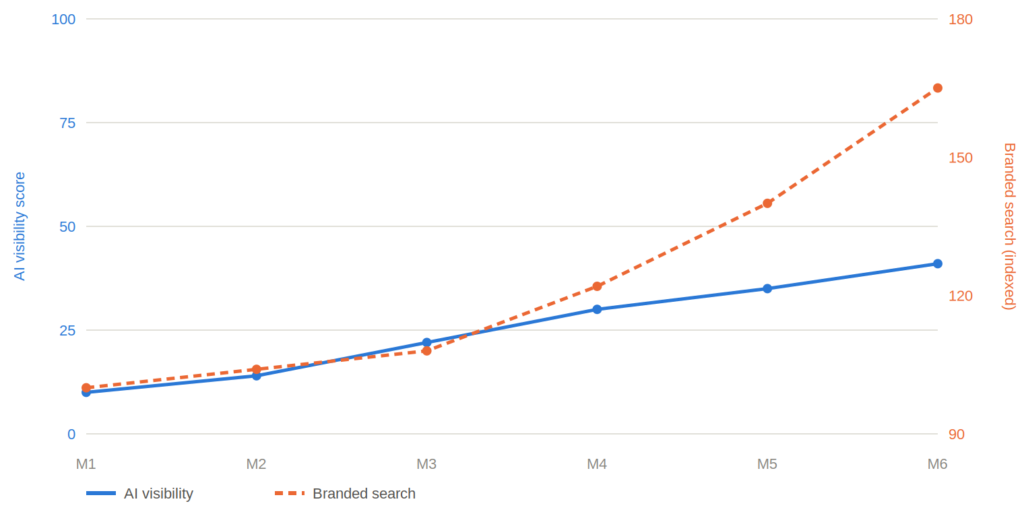
- Watch Direct traffic alongside it. A rise in Direct that tracks your visibility curve—with no campaign, PR push, or event to explain it is a soft but real signal.
- Segment by landing page. AI-influenced visitors tend to skip the top of your funnel. They land on homepage, pricing, and product pages rather than blog posts because the education already happened inside the AI answer. A shift in your entry-page mix toward bottom-funnel pages is a fingerprint worth watching.
What it tells you: Whether AI visibility is generating real demand.
What it can’t tell you: Exactly how much. This is correlation, presented honestly as correlation. Which is fine—say so, show the pattern across multiple cycles, and let the consistency do the persuading.
Layer 4 – Self-reported attribution: the only ground truth you’ll get
The single highest-value thing on this list is also the least glamorous: a “How did you hear about us?” field on your signup or demo form.
Not a dropdown of your own channels. An open field, or a list that explicitly includes AI tools.
This is the only mechanism that recovers the buyer who read about you in ChatGPT three weeks ago, Googled you last Tuesday, and signed up today. No analytics stack can reconstruct that. The buyer can just tell you.
What to do:
- Add the field. Include “ChatGPT / AI assistant” as an explicit option—people won’t volunteer it if the list doesn’t prompt them. Pipe responses into your CRM as a property on the record, not just a form log, so it survives to the deal stage.
- Cross-map data: take everyone who self-reported an AI source and pull their actual acquisition channel from analytics. The mismatch is the insight.
| Self-reported source | Actual channel recorded | What it means |
|---|---|---|
| “Found you on ChatGPT” | Google / Organic | AI created the demand; Google captured the click |
| “Found you on ChatGPT” | Direct | Referrer stripped, or brand recall from a previous session. |
| “Found you on ChatGPT” | chatgpt.com referral | The rare, fully-traceable case |
- Attach revenue. Filter closed-won deals where the contact self-reported an AI source. That number, “X% of closed revenue came from buyers who told us they found us through AI”—is the only AI attribution figure that survives contact with a finance team.
What it tells you: Actual revenue influence.
What it can’t tell you: Anything about people who didn’t fill in the field or misremembered. Response rates are partial and memory is imperfect. Treat it as a strong sample, not a census.
Running It as a System, Not a Dashboard
Four separate numbers in four separate tools isn’t measurement. The value is in the loop.
Here’s the cadence that makes it an engine rather than a report:
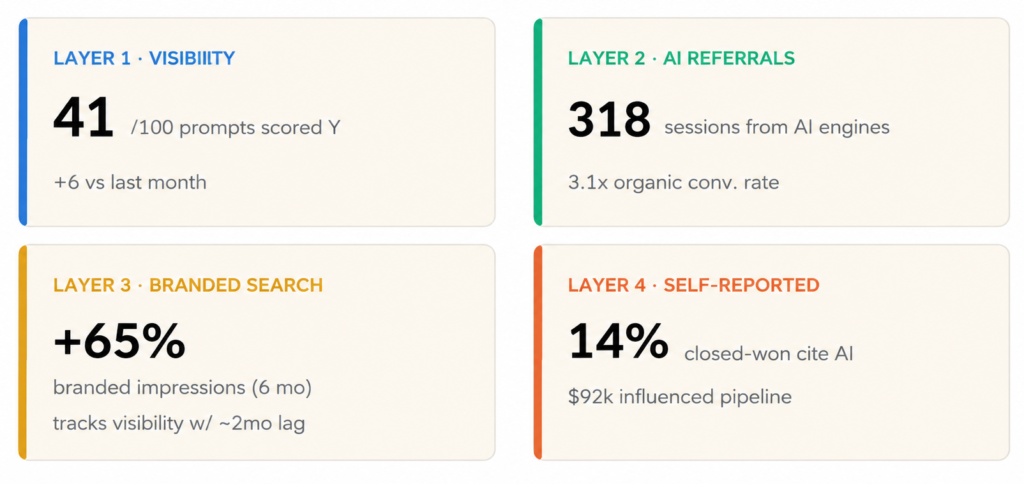
Monthly – Run the prompt set (Layer 1): Where did visibility move? Which prompt groups gained, which are still at zero? Feed that into what you work on next: identity gaps get entity and consistency work, category gaps get third-party editorial work.
Monthly – Check referral and behavioural data (Layer 2): Volume matters less than the trend and the conversion differential.
Quarterly – Overlay visibility against branded search (Layer 3): This is the correlation you build a business case on. It needs several cycles before it means anything, which is exactly why you start logging now.
Quarterly – Pull self-reported attribution against pipeline (Layer 4): This is what goes in the board deck.
The loop closes when Layer 1 movement predicts Layer 3 movement, and Layer 4 confirms it converted. Once you’ve seen that sequence play out even once, you can forecast with it and you can defend the spend before the revenue arrives, because you know how long the lag is.
The Mistakes That Kill the Channel
Reporting Layer 2 as the whole channel. “We got 40 sessions from ChatGPT last month” is a true statement that will get your budget cut. It’s the floor, not the size.
Expecting deterministic attribution. It doesn’t exist here and demanding it means measuring nothing. Probabilistic evidence, consistently gathered, beats a perfect number you’ll never have.
Skipping the form field. It costs one afternoon and it’s the only layer that touches revenue directly. Teams skip it because it’s unglamorous, then spend months trying to reverse-engineer what a dropdown would have told them.
Buying a tool before defining the prompt set. A platform will happily track visibility against its prompts. If you haven’t decided which questions actually matter for your buyers, you’ll get a number that moves without meaning anything.
Judging it on one quarter. The lag between visibility gains and pipeline is real—one published engagement ran eight months before the revenue picture was clear. If you kill it at week ten, you killed it before the measurement window opened.
What You Still Won’t Know
Being straight about the limits is what makes the rest credible:
- The zero-click majority: People who read about you in an AI answer and never click are invisible. They’re real, they’re probably the largest group, and no method here recovers them.
- Which specific prompt drove a specific deal: You can know AI influenced a buyer. You can’t know it was the “best tools for X” query on a Tuesday.
- The full retrieval surface: Because AI systems fan a question out into sub-queries, the prompts you track are a sample of a larger, partly unobservable space.
- Sentiment at scale: Whether AI describes you favourably is as important as whether it mentions you and it’s much harder to track systematically.
None of that invalidates the system. Paid search took years to build reliable attribution. Brand marketing still doesn’t have it and nobody proposes cancelling brand. AI search is a channel you measure the way you measure brand: leading indicators, correlation across cycles, and self-reported truth at the point of conversion.
Start Here, This Week
If you do nothing else:
- Add the “How did you hear about us?” field, with an explicit AI option. It takes one afternoon and has the highest return on this list.
- Write your 15-prompt set and run it once. That’s your baseline. Without it, you can’t prove movement later.
- Build the GA4 AI referrer segment. It takes fifteen minutes, and it stops AI traffic from hiding inside Direct.
- Screenshot your branded search trend today. In three months you’ll want the “before” picture.
Everything else—the tools, the dashboards, the quarterly correlation builds on those four. And they don’t require budget approval.