
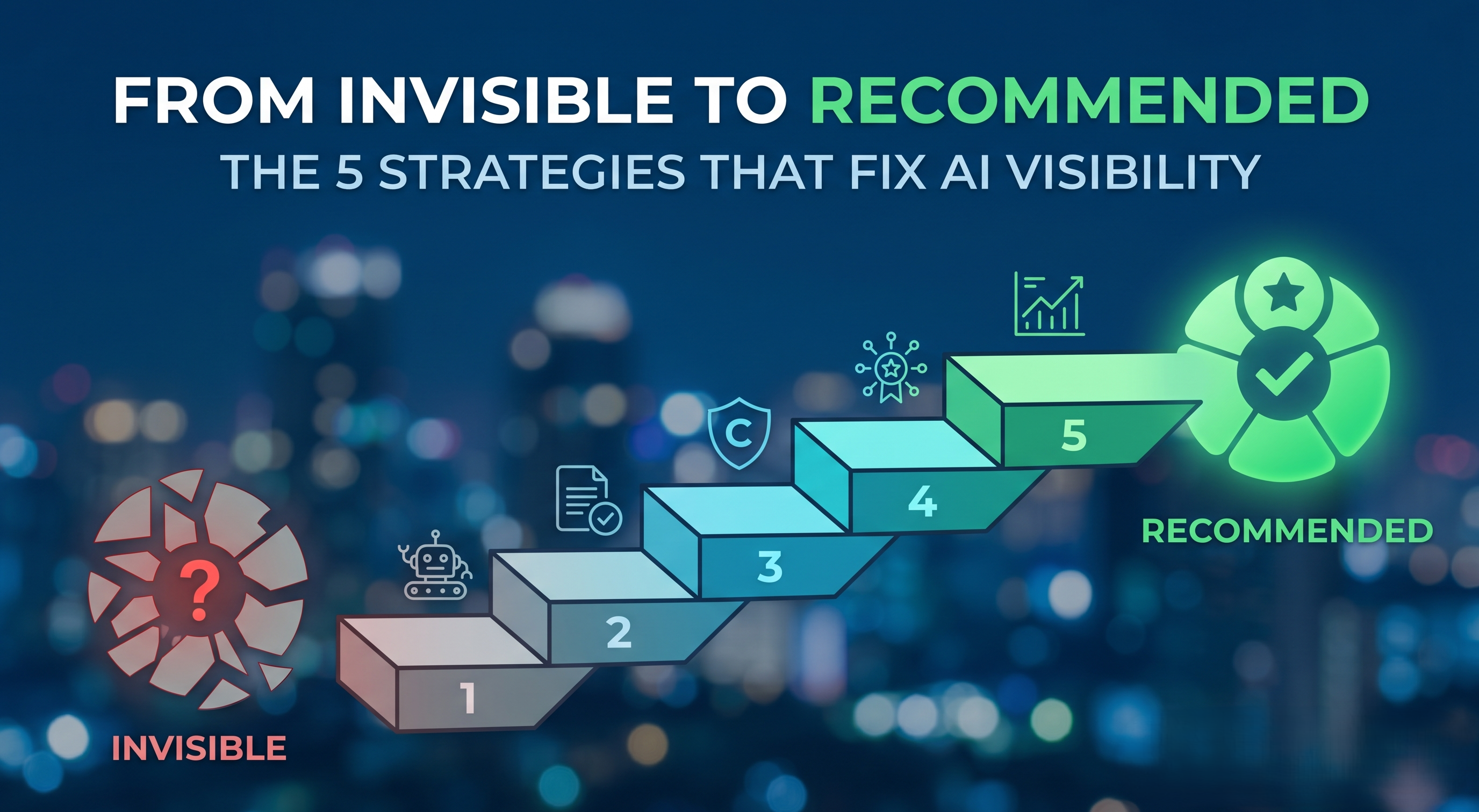

You’ve done the audit. You know the gaps. Now here’s exactly what to do about them—five strategies that move brands from AI-invisible to AI-recommended.
Reading time: 12–14 minutes | Level: Beginner to Intermediate
What You’ll Learn in This Guide
By the end of this article, you will understand exactly:
- The five structural reasons brands are absent from AI-generated answers
- The five corresponding strategies that resolve each one
- How to prioritise which strategy to implement first based on your audit findings
- What each strategy looks like in practice—with specific, actionable steps
- How Odd Screw approaches AI visibility strategy for brands across industries
📌 BEFORE YOU READ THIS
This article is the natural follow-up to our GEO visibility audit guide. If you haven’t run your audit yet, start there—it will tell you which of the five strategies below you need most urgently. This guide explains how to fix what the audit finds. Read the audit guide first →
Table of Contents
1. The AI Visibility Problem is Bigger than Most Brands Realise
Here is a number that should stop every marketer mid-scroll: only 30% of brands that appear in an AI-generated answer show up again in the very next response to the same query. Run the same query five times in a row, and just 20% of brands persist across all five responses, according to the 2026 State of AI Search report from AirOps.
That is not a ranking problem. It is a structural problem. Brands that appear inconsistently in AI answers haven’t built the citation authority, content depth, or entity clarity that AI engines need to confidently recommend them. They’re appearing by chance, not by design.
The brands that appear consistently—the ones in that 20%—share five structural characteristics. They have each built something that most brands have not yet invested in. And the gap between them and the brands that don’t appear is growing, not closing.
Understanding those five characteristics is the first step. Building them is the strategy.
💡 THE STAKES
Brands cited in AI Overviews earn 35% more organic clicks and 91% more paid clicks than brands that don’t appear in those summaries, according to ALMCorp research. This is not a vanity metric. AI citation translates directly into commercial advantage—and 94% of CMOs are now increasing GEO investment as a result.
2. Why Brands Aren’t Showing Up in AI Search—The 5 Root Causes
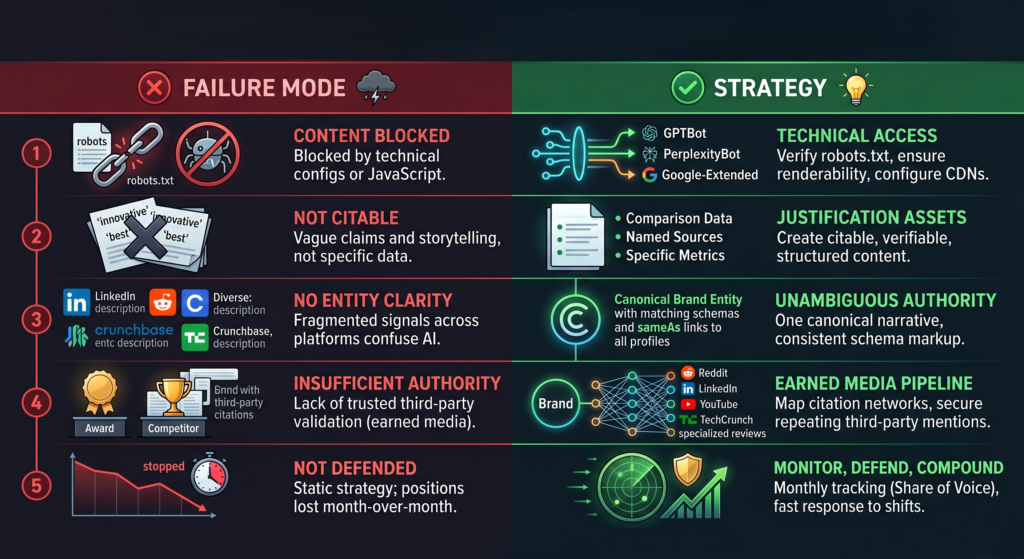
Before the strategies, you need to understand exactly what’s going wrong. In OddScrew’s GEO audits, the same five failure modes appear repeatedly—regardless of industry, company size, or existing SEO performance. Most brands have more than one.
Failure Mode 1—AI Engines Can’t Access Your Content
The most immediately fixable problem and the most commonly overlooked. AI crawlers operate differently from Google’s Googlebot. Many brands have unknowingly blocked them through robots.txt configurations, CDN security settings, or JavaScript-heavy pages that AI bots cannot render. If AI engines can’t read your content, no amount of optimisation will make you visible.
The signal: Your brand is entirely absent from AI-generated answers even for branded queries. Competitors with weaker content appear where you don’t.
Failure Mode 2—Your Content Doesn’t Give AI a Reason to Cite You
AI engines are not looking for good content. They are looking for citable content—content that makes clear, specific, verifiable claims that can be extracted and included in a generated answer. Vague value propositions, marketing-heavy language, and long narrative introductions that bury the answer are the most common structural failures. As research from the Princeton GEO study confirms, content that ranks well in Google and content that gets cited by AI are increasingly different things.
The signal: Your content ranks well in Google but rarely appears in AI-generated answers. When it does appear, it’s cited for peripheral points rather than your core value proposition.
Failure Mode 3—Your Brand Doesn’t Exist Clearly Enough as an Entity
AI engines build their understanding of your brand by cross-referencing multiple sources. If your brand name, description, services, and positioning are described inconsistently across your website, LinkedIn, Google Business Profile, third-party directories, and press mentions—the AI encounters conflicting signals and either produces an inaccurate description or deprioritises you entirely. In AI search, consistency of entity signals is the equivalent of domain authority in traditional SEO.
The signal: AI engines describe your brand inaccurately, incompletely, or inconsistently. Different platforms produce different descriptions of the same brand.
Failure Mode 4—You Have Insufficient Earned Media Authority
This is the most structurally significant failure mode—and the hardest to fix quickly. AI engines are fundamentally biased toward earned media: third-party reviews, editorial publications, expert commentary, and authoritative institutional sources. Unlike Google, which balances brand-owned content, earned media, and social signals, AI engines heavily favour third-party sources. A brand with excellent owned content but limited earned media presence will consistently underperform in AI search relative to its Google rankings.
The signal: Competitors with weaker websites appear ahead of you in AI answers because they have stronger coverage in industry publications, review platforms, and community forums that AI engines trust.
Failure Mode 5—You Have No System for Monitoring and Defending Your Position
Between 40% and 60% of cited sources change month-to-month across ChatGPT and Google AI Mode, according to SEL research. AI visibility is not static—it shifts as models update, competitors optimise, and new sources enter the citation network. Brands that earn AI visibility and then stop investing in it will lose ground quietly and quickly. Without a monitoring system, you have no early warning when this happens.
The signal: You appeared in AI answers a few months ago but citation frequency has dropped. You don’t know why or when it happened.
📊 ROOT CAUSE SUMMARY
Most brands failing in AI search have more than one of these problems simultaneously. The order matters: fix crawler access first, then entity clarity, then content structure, then earned media, then monitoring. Each layer depends on the one beneath it. Investing in earned media before fixing technical access is like building on an unstable foundation.
3. The 5 Strategies to Improve AI Search Visibility
Each strategy directly addresses one of the five failure modes above. They are sequenced deliberately—the first strategy creates the foundation every subsequent strategy depends on. To make that relationship clearer, here’s a simplified view of how each failure mode maps directly to its corresponding GEO fix.
Strategy 1—Make Your Brand Technically Readable by AI
Fixes: Failure Mode 1 — AI Engines Can’t Access Your Content
Before AI engines can cite you, they need to be able to find and read you. This sounds obvious, but it is the first thing OddScrew checks in every GEO audit—because it is the most common issue we find and the one that makes every other strategy pointless if unresolved.
The three things to fix immediately:
- Check your robots.txt file at yourdomain.com/robots.txt. Look for Disallow rules blocking GPTBot, PerplexityBot, ClaudeBot, or Google-Extended. If any are blocked, your content is invisible to those engines regardless of quality.
- Disable JavaScript in your browser and visit your key pages. If your core content disappears—your services, about page, key articles—AI crawlers are seeing an empty page. Most AI bots cannot execute JavaScript. The solution is server-side rendering for content that matters.
- If you use Cloudflare, verify your bot management settings. Cloudflare changed its default configuration in 2024 to block AI crawlers—meaning brands using it may have been invisible to AI search for months without realising it.
Once resolved, these fixes take effect within weeks as AI crawlers revisit and re-index your content. This is the highest return-on-time investment in the entire GEO strategy.
⚡ QUICK WIN
Run this test right now: go to <yourdomain>.com/robots.txt and search for the word ‘GPTBot’. If it appears under a Disallow rule, AI crawlers from OpenAI are blocked from your site. That single line may be the reason your brand doesn’t appear in ChatGPT answers.
Strategy 2—Build Justification Assets, Not Just Content
Fixes: Failure Mode 2 — Your Content Doesn’t Give AI a Reason to Cite You
The shift from traditional SEO content to GEO content requires a fundamental change in how you think about what you’re creating. In traditional SEO, you are writing for a reader who arrived at your page by choice. In GEO, you are writing for an AI that is assembling a shortlist of recommendations for a potential customer who may never visit your site directly.
That AI needs one thing from your content: justification. A clear, extractable reason why your brand is the right answer to a specific question.
What justification assets look like in practice:
- Replace vague value propositions with specific, verifiable ones. Not ‘industry-leading expertise’ but ‘the only GEO agency in B2B SaaS offering a 48-hour audit with a competitive citation gap map included’
- Open every key section with a direct, one-sentence answer before expanding. AI systems that scan your page for citable content will pull the first clear statement they find—if your answer is buried three paragraphs in, it will be skipped
- Build comparison content explicitly. Create pages that contrast your approach against alternatives—pros and cons, side-by-side comparisons, ‘X vs Y’ content. According to research, comparison content is among the most frequently cited formats in AI-generated answers
- Include specific data points with named sources in every key piece of content. Vague claims are not citable. ‘AI referral traffic converts 31% better than other channels, according to Adobe Analytics’ is citable. ‘AI drives better conversions’ is not
- Create content clusters, not isolated pages. A topical cluster of interlinked pages on a subject signals to AI systems that your brand has genuine depth on a topic—making you a more reliable citation source than a brand with a single optimised page
The test for every piece of content: can an AI extract a specific, confident, verifiable claim from this page in under 30 seconds? If not, restructure it until it can.
Strategy 3—Establish Unambiguous Entity Authority
Fixes: Failure Mode 3 — Your Brand Doesn’t Exist Clearly Enough as an Entity
In AI search, your brand is not a website. It is an entity—a defined, consistent, cross-referenced concept that AI engines build by synthesising signals from dozens of sources simultaneously. Entity clarity is the AI equivalent of domain authority. Without it, even excellent content and strong earned media coverage cannot produce consistent citation.
The practical steps to build entity authority:
- Write one canonical brand description—a single, clear, positioning statement that describes exactly what you do, who you do it for, and what makes you different. This exact description must appear on your website About page, LinkedIn company profile, Google Business Profile, all directory listings, and your schema markup. Consistency is the signal; variation is the noise.
- Implement Organisation schema markup on your homepage and About page with sameAs links connecting your brand profiles across the web—LinkedIn, Crunchbase, Companies House, industry directories. This explicitly tells AI engines that these profiles all refer to the same entity.
- Add named, credentialled authors to all your content. Named entities give AI systems a confidence signal that content is grounded in something real and verifiable. ‘A GEO agency’ is a category. ‘Odd Screw, a specialist GEO agency founded in New Delhi in 2026’ is an entity.
- Search your brand name in ChatGPT and Perplexity and audit how they describe you. Any inaccuracy is a signal that your entity definition is not strong or consistent enough to override the conflicting information AI engines have found elsewhere. Fix the source of conflicting information, not just the AI output.
Strategy 4—Build a Systematic Earned Media Pipeline
Fixes: Failure Mode 4 — You Have Insufficient Earned Media Authority
This is the most important strategy in GEO—and the most commonly underinvested in. AI engines, unlike Google, are fundamentally biased toward earned media. ChatGPT in particular consistently suppresses brand-owned content in favour of third-party editorial sources. Your own website, however well optimised, is not sufficient on its own. As the research puts it: AI doesn’t follow links, it detects patterns. Recognition comes from repetition, association, and context.
Nike doesn’t need to rank for ‘best running shoes’ to be included in AI-generated answers. It has been mentioned in product reviews, customer testimonials, sports journalism, blogs, Wikipedia, YouTube videos, and Reddit threads—everywhere. That widespread, consistent, third-party recognition means AI engines cite Nike with confidence. That is the model.
Building an earned media pipeline for GEO requires a different approach than traditional PR:
- Map your citation network first. Before pursuing coverage, run your core queries in ChatGPT and Perplexity and identify which specific publications, review sites, and community platforms AI engines are already citing in your vertical. Those are your priority targets—not general PR placements but the specific sources AI engines in your category already trust.
- Pursue features and expert commentary in those specific sources. A single citation in a publication that AI engines consistently reference is worth more for GEO than ten mentions in publications that don’t feature in AI answers.
- Build presence in the three platforms AI engines cite most consistently: Reddit, LinkedIn, and YouTube. A detailed, expert answer in a relevant Reddit thread, a LinkedIn article on a core topic, a YouTube explanation of a concept your audience searches—each of these is a source AI engines can draw on that your own website cannot replace.
- Create original research and data. Original research is the single most powerful earned media catalyst available. A proprietary study, benchmark report, or original dataset gives publications a reason to cite you—and gives AI engines a specific, verifiable data point to extract from your brand’s output.
- Make earned media a continuous programme, not a sporadic campaign. AI engines update their citation patterns as new sources enter the ecosystem. A brand that earns strong coverage in Q1 and goes quiet in Q2 will see its AI visibility erode as competitors’ newer content displaces it.
Strategy 5—Monitor, Defend and Compound
Fixes: Failure Mode 5 — You Have No System for Monitoring and Defending Your Position
The brands that sustain AI visibility treat it the way sophisticated brands once treated paid search—as an ongoing competitive discipline with regular measurement, fast response to position loss, and continuous compounding of authority over time.
The monitoring framework Odd Screw recommends:
- Run your core query set—the 10 to 15 queries that matter most commercially — across ChatGPT, Perplexity, and Google AI Overviews every month. Document citation frequency, citation context, and competitive positioning. This is your GEO scorecard.
- Track Share of Voice—the percentage of your tracked queries in which your brand appears. This single metric is more useful than any other for understanding your AI visibility position and measuring progress over time.
- Set up GA4 custom channel groupings to capture AI referral traffic from chatgpt.com, perplexity.ai, claude.ai, and you.com. While not comprehensive, directional traffic data confirms whether AI visibility improvements are translating into website visits and conversions.
- When a competitor gains ground on a query you previously held, respond within the month. Create a more comprehensive justification asset for that query, target a new earned media placement in a source the competitor is being cited from, or strengthen schema markup on the relevant page.
- Run a full technical audit quarterly—schema errors, crawler access issues, and entity signal inconsistencies can emerge as your site evolves. Monthly monitoring catches citation drops; quarterly audits catch the technical root causes.
The compounding effect is real and significant. Once a brand becomes established as an authoritative source in AI engines’ citation networks, it tends to be cited more frequently—creating a virtuous cycle that becomes increasingly difficult for competitors to break into. Starting that cycle early, when Citation Gaps are still closable, is the strategic advantage that separates the brands winning AI search from the ones still figuring out what GEO means.
4. Which Strategy should you Prioritise?
The right starting point depends on what your GEO audit revealed. Use this framework to identify your highest-leverage action:
| If your audit found… | Start with… | Why |
|---|---|---|
| Brand completely absent from all AI answers | Strategy 1 — Technical Access | Crawler blockage is the most common cause of complete AI invisibility. Fix this before anything else |
| Brand described inaccurately by AI engines | Strategy 3 — Entity Authority | Inaccurate descriptions signal entity fragmentation. No content investment will fix this until entity signals are consistent |
| Brand appears sometimes but inconsistently | Strategy 2 — Justification Assets | Inconsistent appearance means AI engines find you but lack confident citable content to include you reliably |
| Competitors appearing ahead of you consistently | Strategy 4 — Earned Media Pipeline | Competitive citation gaps are almost always an earned media authority problem. Your competitors have better third-party coverage |
| Visibility declining month-on-month | Strategy 5 — Monitor and Defend | Declining visibility without a clear trigger means competitors are actively building authority. Set up monitoring first to understand exactly where and why |
📌 ODDSCREW’S RECOMMENDATION
In practice, Strategies 1 and 3 can be executed simultaneously since both are primarily technical and can be resolved within the first 30 days. Strategy 2 runs in parallel as a content programme. Strategy 4 is the long-term investment that produces the most durable results. Strategy 5 ties everything together as the ongoing management layer. This is the exact sequence OddScrew follows in every GEO engagement.
5. What to Expect — Realistic Timelines
One of the most important things to set correctly in GEO is expectations. Unlike paid search, which can produce results within hours, GEO is a compounding discipline. Here is a realistic timeline:
| Strategy | Time to first results | Time to consistent impact |
|---|---|---|
| Technical access fixes | 2–4 weeks | 4–6 weeks |
| Entity authority signals | 4–6 weeks | 6–10 weeks |
| Justification asset content | 6–8 weeks | 10–14 weeks |
| Earned media pipeline | 8–12 weeks | 3–6 months |
| Monitoring and defence | Immediate tracking | Ongoing—compounds over time |
The critical insight in these timelines is the compounding dynamic. A brand that invests consistently in all five strategies for six months will have built citation authority that is genuinely difficult for a competitor to displace quickly—because earned media coverage, entity recognition, and content citation history all take time to build and are not easily replicated. Early movers in GEO are accumulating a structural advantage that grows, not shrinks, with time.
6. Frequently Asked Questions
No—and attempting to do so without adequate resource is less effective than sequencing them correctly. Fix technical access first since it is a prerequisite for everything else. Run entity authority and justification assets in parallel once technical issues are resolved. Layer earned media as an ongoing programme alongside those. Monitoring runs continuously from the start. The sequencing matters more than the speed.
Because AI engines and Google use fundamentally different signals. Google rewards keyword relevance, backlink authority, and technical health. AI engines reward entity clarity, earned media coverage, content extractability, and third-party validation. The overlap exists—strong SEO is a prerequisite for GEO—but the gap between the two has grown significantly. Strong SEO gets you into the ecosystem. GEO strategy determines whether you’re cited within it.
Technical fixes can produce measurable improvements within four to six weeks. Brands that have resolved crawler access issues and standardised entity signals have reported appearing in AI answers within that window. Content and earned media improvements take longer—typically eight to fourteen weeks for content, three to six months for earned media-driven citation authority. Some brands have seen measurable improvements in as little as ten days after resolving a specific technical blockage, but consistent, reliable AI visibility across multiple platforms and query types is a three to six month programme.
Strategies 1 and 3—technical access and entity clarity—are highly executable in-house with clear guidance. Strategy 2—justification assets—requires content creation capacity and a clear brief for what AI-citable content looks like in practice. Strategy 4—earned media—is the most resource-intensive and benefits most from specialist support, since identifying the right citation network and executing a sustained PR programme while managing day-to-day business is challenging without dedicated resource. Strategy 5—monitoring—can be handled in-house using manual audit methods or supported by dedicated GEO tools depending on the scale of your operation.
Odd Screw is a specialist GEO agency, not an SEO agency that has added GEO as a service. The distinction matters because GEO requires a different methodology, different tools, and a different measurement framework from traditional SEO. Specifically: we map citation networks for each AI platform separately rather than applying a single cross-platform strategy; we build justification assets rather than general content; we run earned media programmes targeted at the specific sources AI engines already cite in your vertical rather than general PR; and we measure Share of Voice in AI-generated answers as the primary KPI rather than organic traffic or ranking position.
Final Thought: The Gap Closes From the Inside
The Citation Gap between brands that appear consistently in AI answers and those that don’t is not primarily a resource gap. It is a structural gap—a difference in how content is built, how brand identity is managed across the web, and how authority is earned in the sources AI engines trust.
The five strategies in this article close that gap from the inside. Not by gaming AI systems, but by becoming the kind of source that AI engines are designed to recommend—authoritative, clear, consistent, and verifiably credible.
The brands that build these five structural characteristics now will find themselves in a compounding advantage that becomes harder to displace with every passing quarter. The brands that wait will find the gap increasingly expensive to close.
The window is open. But it is not indefinitely open.
🚀 READY TO CLOSE YOUR CITATION GAP?
OddScrew’s GEO visibility audit identifies exactly which of the five failure modes are holding your brand back—and delivers a prioritised strategy for resolving them within 48 hours. The audit is complimentary. The advantage it creates is yours to build on. Book yours today.
Also read: GEO, AEO, AI SEO — What’s the Difference and Which One Does Your Brand Actually Need? →
Also read: Is Your Brand Invisible to AI? How to Run a GEO Visibility Audit →