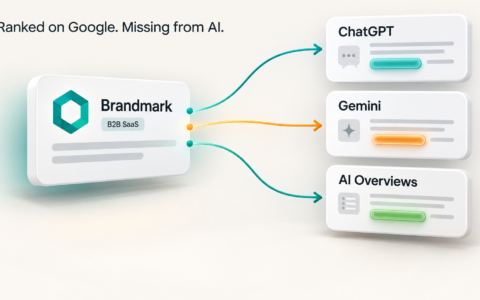

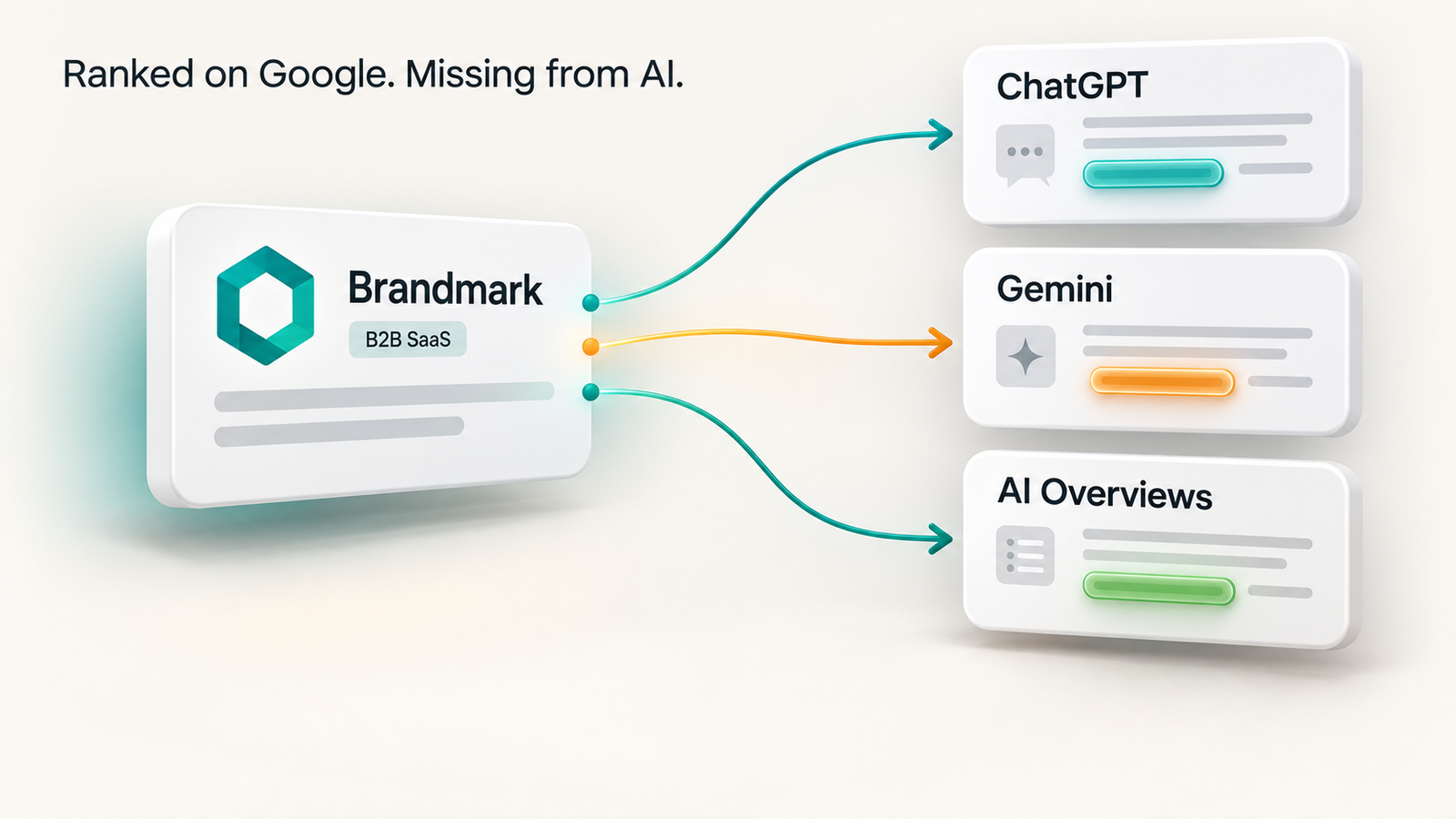

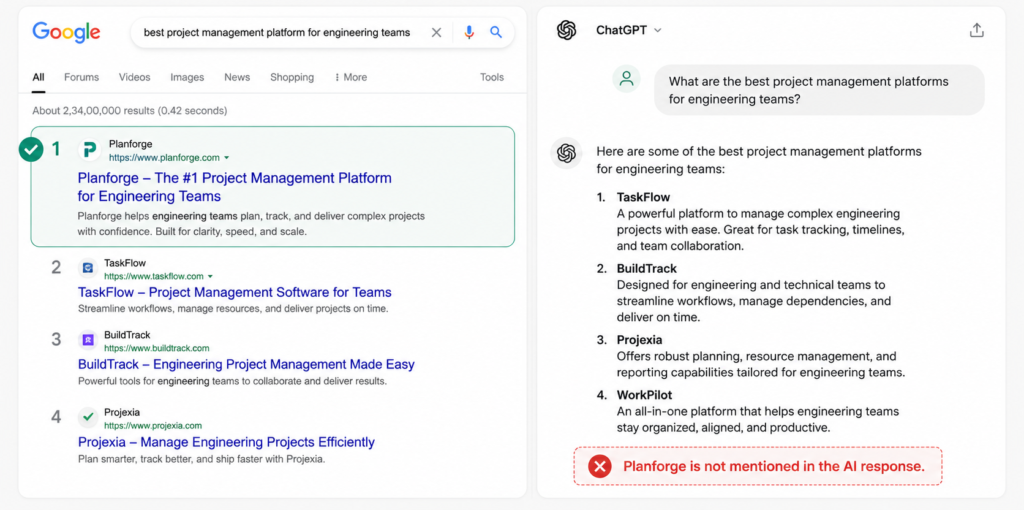
Your website ranks on page one. Your blog drives thousands of visits a month. But when a buyer asks ChatGPT or Gemini for the best solution in your category, your brand doesn’t exist. That gap has a name: AI visibility.
The Question B2B Brands Aren’t Asking Yet
Every B2B marketing team tracks organic rankings, domain authority, and search traffic. These metrics have driven growth strategies for over a decade. And they still matter.
But something has shifted in how buyers discover products and services.
A growing number of B2B buyers are no longer starting their research on Google. They’re opening ChatGPT, Gemini, Perplexity, or Microsoft Copilot and asking questions like:
- What’s the best project management tool for remote engineering teams?
- Which cybersecurity platforms are best for mid-market SaaS companies?
- What compliance software should a Series B fintech use?
These aren’t hypothetical queries. They’re real discovery behaviors that are reshaping how B2B purchase decisions begin. And when an AI engine answers these questions, it doesn’t pull from the same signals Google uses to rank websites.
It pulls from a completely different set of inputs and most B2B brands aren’t optimising for any of them.
That’s the problem AI visibility solves.
What Is AI Visibility?
AI visibility is the measure of how often, how accurately, and how favorably AI engines like ChatGPT, Google Gemini, Perplexity, Microsoft Copilot, and others—reference, recommend, or cite your brand when users ask questions relevant to your category.
It’s not a rebrand of SEO. It’s not a feature inside your existing search strategy. It’s a parallel channel with its own inputs, its own ranking logic, and its own optimisation playbook.
Here’s the simplest way to understand the difference:
SEO visibility – your brand appears in search engine results when someone types a query.
AI visibility – your brand is named and recommended when someone asks an AI engine for help with a problem you solve.
The distinction matters because these two outcomes are driven by fundamentally different signals. A brand can rank #1 on Google for its primary keyword and be completely absent from AI-generated recommendations. We’ve seen this repeatedly and it’s one of the most common findings in the AI visibility audits we run for B2B companies.
Why AI Visibility Matters for B2B Specifically
B2B buying behavior makes AI visibility disproportionately important compared to B2C. Three structural reasons:
1. B2B buyers research before they ever fill out a form
The average B2B purchase involves 6 to 10 decision-makers and a research phase that can last weeks or months. Increasingly, that early-stage research is happening in AI tools, not because buyers trust AI more than Google, but because AI gives them synthesized, comparative answers faster than reading ten blog posts.
When a VP of Engineering asks Gemini, “What are the best customer onboarding platforms for B2B SaaS companies?” and your platform isn’t named, you’ve lost influence at the moment it matters most i.e., before the buyer has built a shortlist.
2. AI recommendations carry implicit endorsement
When Google shows ten blue links, the buyer understands they’re looking at algorithmically ranked results. When ChatGPT says “Based on your requirements, I’d recommend [Brand X] because…”, that carries a different weight. It reads as advice, not a result set.
For B2B brands, being the company AI recommends by name during the research phase is the equivalent of being the vendor a trusted advisor suggests in a meeting.
3. Traditional SEO metrics don’t capture this channel
Your analytics dashboard shows organic traffic, keyword rankings, and conversion rates from Google. But when a buyer discovers your brand through an AI conversation, clicks through to your website, and eventually fills out a demo form, your CRM attributes that lead to “Direct” or “Organic” traffic. The AI discovery channel is invisible to standard attribution models.
This means many B2B companies are already generating pipeline from AI recommendations and don’t know it. (We’ve written a dedicated framework for measuring AI search impact that addresses this gap.)
AI Visibility vs. SEO vs. GEO: Clearing Up the Terminology
The space is still new enough that terminology overlaps and confuses. Here’s how the core concepts relate:
Search Engine Optimisation (SEO) optimises for traditional search engine rankings. The primary signals are backlinks, on-page content relevance, technical site health, and user engagement. The outcome is appearing in Google, Bing, or other search engine results pages.
Generative Engine Optimisation (GEO) is the practice of optimising your brand’s digital presence so that generative AI engines cite, reference, and recommend you in their responses. GEO is the discipline i.e., the set of tactics and strategies you apply.
AI Visibility is the outcome i.e., the measurable result of effective GEO. When your GEO efforts work, your AI visibility increases: AI engines mention you more often, more accurately, and more favorably.
Think of it this way: SEO is to organic rankings as GEO is to AI visibility. SEO and GEO are practices. Organic rankings and AI visibility are the results those practices produce.
| SEO | GEO | |
|---|---|---|
| What it optimises for | Traditional search rankings | AI recommendations and citations |
| Primary signals | Backlinks, on-page content, technical SEO | Entity data, citation-ready content, third-party mentions |
| Outcome | Appearing in Google/Bing results | Being named by ChatGPT, Gemini, and other AI engines |
| Example | “Best CRM software” | “Which CRM should we use” |
The 3 Layers of AI Visibility
Through auditing dozens of B2B brands for AI visibility, we’ve identified three distinct layers that determine whether AI engines will recommend your brand. Each layer builds on the one below it, you can’t shortcut to Layer 3 without the foundation of Layers 1 and 2.
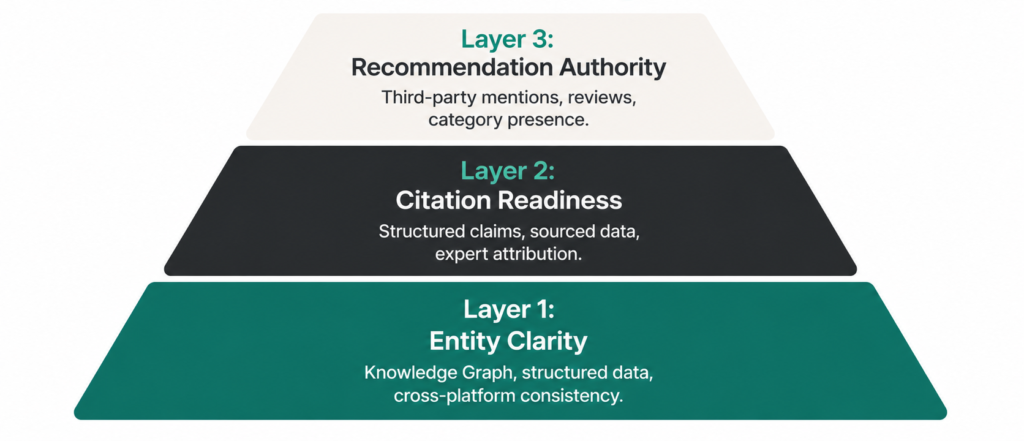
Layer 1: Entity Clarity
Before an AI engine can recommend your brand, it needs to recognize your brand as a distinct entity in your category.
AI models build their understanding of the world from structured data, knowledge graphs, and entity relationships. If your brand’s entity data is inconsistent, incomplete, or confused with other entities, AI literally cannot form a confident recommendation, even if your content is excellent.
Entity clarity means:
- Knowledge Graph recognition: Does Google’s Knowledge Graph identify your brand as a distinct entity? Do you have a Knowledge Panel? Is the information in it accurate?
- Structured data consistency: Does your website’s schema markup (Organization schema, Product schema, FAQ schema) clearly define who you are, what you do, and what category you belong to?
- Cross-platform entity alignment: Is your brand name, description, and category consistent across your website, LinkedIn, G2, Capterra, Crunchbase, and other platforms AI models use as training and retrieval sources?
- Entity disambiguation: If your brand name is similar to other entities (common words, shared names with companies in different industries), have you taken steps to create clear separation?
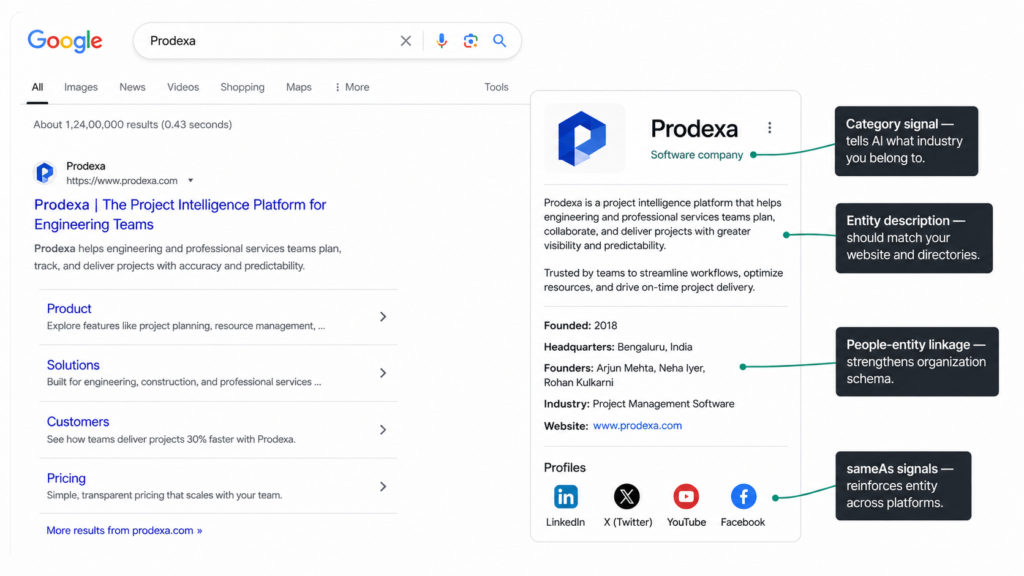
Entity clarity is the foundation. Without it, the layers above can’t function—AI engines won’t recommend a brand they can’t confidently identify.
Layer 2: Citation Readiness
Once AI recognizes your brand, it needs content it can actually extract, cite, and attribute to you.
AI engines don’t cite content the way humans read it. They extract specific claims, data points, and structured information. Most B2B content is written for human engagement—compelling headlines, emotional hooks, broad narrative claims. That content might perform well on Google. But it’s often invisible to AI because it lacks the structural signals AI needs to extract and cite.
Citation-ready content has:
- Specific, verifiable claims: “Our platform reduces deployment time by 30% for mid-market engineering teams” is citable. “We help companies deploy faster” is not.
- Named data points and statistics: AI engines prioritize content with concrete numbers, sourced data, and attributable metrics.
- Expert attribution: Claims tied to named experts, published research, or identifiable sources carry more weight than anonymous assertions.
- Structured formatting: Clear headings, definition structures, comparison tables, and FAQ formats make it easier for AI to extract and attribute specific answers to your content.
- Topical depth: AI engines favor content that demonstrates comprehensive expertise on a subject rather than surface-level overviews. A 3,000-word guide that covers a topic thoroughly is more citable than six 500-word posts that skim the surface.
The gap we see most often in B2B audits is companies with strong content that’s written entirely for human readers. The content is good but it just isn’t structured for AI extraction.
Layer 3: Recommendation Authority
Entity clarity and citation-ready content create the possibility of being recommended. Recommendation authority is what pushes AI engines to actually prefer your brand over alternatives.
This layer is about signals that exist outside your own website i.e., third-party indicators that tell AI models your brand is a credible, relevant option in its category.
Recommendation authority signals include:
- Third-party mentions in context: Are you mentioned in industry publications, expert roundups, comparison articles, and directory listings in the context of your specific category? AI engines treat contextual mentions from authoritative sources as strong recommendation signals.
- Review platform presence: Your profiles on G2, Capterra, TrustRadius, and similar platforms serve as structured data sources that AI models use to validate brand claims and form recommendations.
- Backlink quality in context: While backlinks are primarily an SEO signal, backlinks from contextually relevant, authoritative sources also reinforce your entity profile and recommendation authority in AI models.
- Recency and activity: AI engines factor in how recently your brand has been mentioned, how active your digital presence is, and whether your information is current. Stale brands lose recommendation authority over time.
Layer 3 is the hardest to build and the hardest to fake. It requires genuine authority in your category, the kind that comes from being a credible option that other people talk about, not just from what you say about yourself.
This is also the layer where B2B brands with strong partner ecosystems, active customer communities, or frequent industry participation have a natural advantage. Every webinar you co-host, every guest post you publish, every case study a customer shares publicly—these all create the third-party contextual signals that AI models use to validate recommendation decisions.
The mistake we see most often: brands trying to jump straight to Layer 3 tactics (PR campaigns, directory submissions) without fixing Layer 1 and 2 first. If AI doesn’t recognize your entity or can’t extract citable claims from your content, all the third-party mentions in the world won’t produce recommendations. The layers are sequential for a reason.
How to Check Your AI Visibility Right Now
You don’t need specialized tools to get a baseline reading of your brand’s AI visibility. Here’s a practical starting point:
Step 1: Run the recommendation query. Open ChatGPT, Gemini, and Perplexity. Ask each one: “What are the best [your category] tools/platforms/agencies for [your ICP]?” Note whether your brand is mentioned, how it’s described, and which competitors appear.
Step 2: Run the entity query. Ask: “What is [your brand name]?” and “Tell me about [your brand name].” Check whether AI engines correctly identify your company, your category, and your key differentiators. Inaccuracies here point to entity clarity problems.
Step 3: Run the comparison query. Ask: “Compare [your brand] vs. [top competitor].” If AI can’t generate a meaningful comparison, your brand’s entity profile is likely too thin for AI to work with.
Step 4: Google your brand name. Look for a Knowledge Panel on the right side of the results page. If you don’t have one, or if the information in it is wrong, that’s a Layer 1 gap.
Step 5: Check your content’s citation structure. Pick your three highest-traffic blog posts. Ask yourself: does each post contain specific, sourced claims that AI could extract and attribute to you? Or is it primarily narrative content with broad assertions?
These five checks take about 20 minutes and will tell you whether your AI visibility is strong, weak, or nonexistent. For most B2B brands, the answer is somewhere between weak and nonexistent—which means the opportunity is wide open.
The Business Impact: What Changes When You Have AI Visibility
The practical question every B2B leader asks: what does AI visibility actually produce?
Based on what we’ve observed working with B2B brands across SaaS, professional services, and technology:
Shortlist inclusion at the research stage. When your brand is named in AI recommendations, you enter the buyer’s consideration set before they’ve visited your website, read your blog, or talked to your sales team. In B2B, getting on the shortlist is often harder than winning the deal—AI visibility solves the hardest part of the funnel.
Brand authority that compounds. Unlike paid advertising, which stops producing the moment you stop spending, AI visibility compounds. As your entity profile strengthens, your citation footprint grows, and your recommendation authority builds, AI engines become more likely to recommend you over time—not less. The early investment creates a moat.
A discovery channel your competitors aren’t measuring. Most B2B brands can’t even see AI-driven pipeline in their current analytics setup. (Our 4-Layer Attribution Framework addresses exactly this measurement gap.) The companies that figure out how to measure and optimise this channel now are building on a foundation their competitors haven’t even identified yet.
Competitive differentiation in crowded categories. In categories with dozens of similar solutions, AI visibility can be the tiebreaker. When a buyer asks AI for the “best” option and your brand appears with specific, credible positioning while three competitors don’t appear at all, that asymmetry shapes the decision before the comparison spreadsheet is ever built.
What AI Visibility Is Not
A few misconceptions worth clearing up:
AI visibility is not “just SEO with a new name.” The signal sets overlap in some areas (content quality, authority) but diverge in others (entity data, structured claims, citation formatting). A brand can have excellent SEO and zero AI visibility, and vice versa.
AI visibility is not about gaming AI outputs. You cannot keyword-stuff your way into AI recommendations the way early SEO allowed you to game Google rankings. AI recommendation signals are harder to manipulate because they depend on genuine authority, consistent entity data, and third-party validation.
AI visibility is not only for large enterprises. In fact, the opportunity is often larger for mid-market and growth-stage B2B companies. Enterprise brands with massive digital footprints often have some AI visibility by default. Smaller brands that build AI visibility intentionally can punch above their weight in AI recommendations, showing up alongside competitors ten times their size.
AI visibility is not a one-time fix. Like SEO, it’s an ongoing optimisation practice. AI models are retrained and updated regularly, and the signals they weight are evolving. What gets your brand recommended today may not be sufficient in twelve months.
Get a Free AI Visibility Snapshot
Want to know where your brand stands across all three layers? We run complimentary AI visibility snapshots for B2B brands—a quick assessment of your entity clarity, citation readiness, and recommendation status across AI engines like ChatGPT, Gemini, and others.
No pitch. No commitment. Just a clear picture of where you stand and what the gaps are.