

Most brands are optimising for Google. Meanwhile, AI engines are answering their customers’ questions—and recommending their competitors. Here’s how to find out exactly where you stand.
Reading time: 12–14 minutes | Level: Beginner to Intermediate
What You’ll Learn in This Guide
By the end of this article, you will know exactly:
- What a GEO visibility audit is and why every brand needs one in 2026
- The five components every audit must cover
- How to run a manual audit across ChatGPT, Perplexity, and Google AI Overviews—step by step
- What your results mean and what to do about them
- Which tools can help you monitor AI visibility on an ongoing basis
- How to turn audit findings into a prioritised action plan
📌 QUICK DEFINITION
A GEO visibility audit is a structured assessment of how your brand currently appears—or fails to appear—in AI-generated answers across ChatGPT, Perplexity, Google AI Overviews, and other major AI search platforms. It answers one critical question: when a potential customer asks an AI engine about your category, does your brand show up?
Table of Contents
1. Why Most Brands Are Optimising Blind
According to McKinsey, only 16% of brands currently track their performance in AI search. That means 84% of businesses have no idea whether they are visible, invisible, or actively being misrepresented in the AI-generated answers their potential customers are reading every day.
This isn’t a niche problem. As we explored in our complete guide to GEO, ChatGPT now has over 900 million weekly active users, Google AI Overviews appear on 48% of all tracked queries, and AI-referred traffic converts 31% better than any other channel according to Adobe Analytics. AI search is increasingly becoming an active, measurable channel that is already influencing buying decisions at scale.
The audit is where every effective GEO strategy begins. Without it, you are optimising blind—investing in content and authority-building without knowing whether it’s translating into AI citation or not.
💡 KEY INSIGHT
A page can rank #1 on Google and never appear in a single AI-generated answer. Research from Brandlight found that the overlap between top Google rankings and AI-cited sources has dropped from 70% to below 20%. Your Google performance may not fully reflect your AI visibility. Only an audit can.
2. What a GEO Visibility Audit Actually Covers
A GEO audit is fundamentally different from a traditional SEO audit. Where an SEO audit examines your website’s technical health and keyword rankings, a GEO audit examines your brand’s footprint across the entire information ecosystem that AI engines draw from—including third-party publications, community platforms, review sites, and social channels.
A comprehensive GEO audit covers five components:
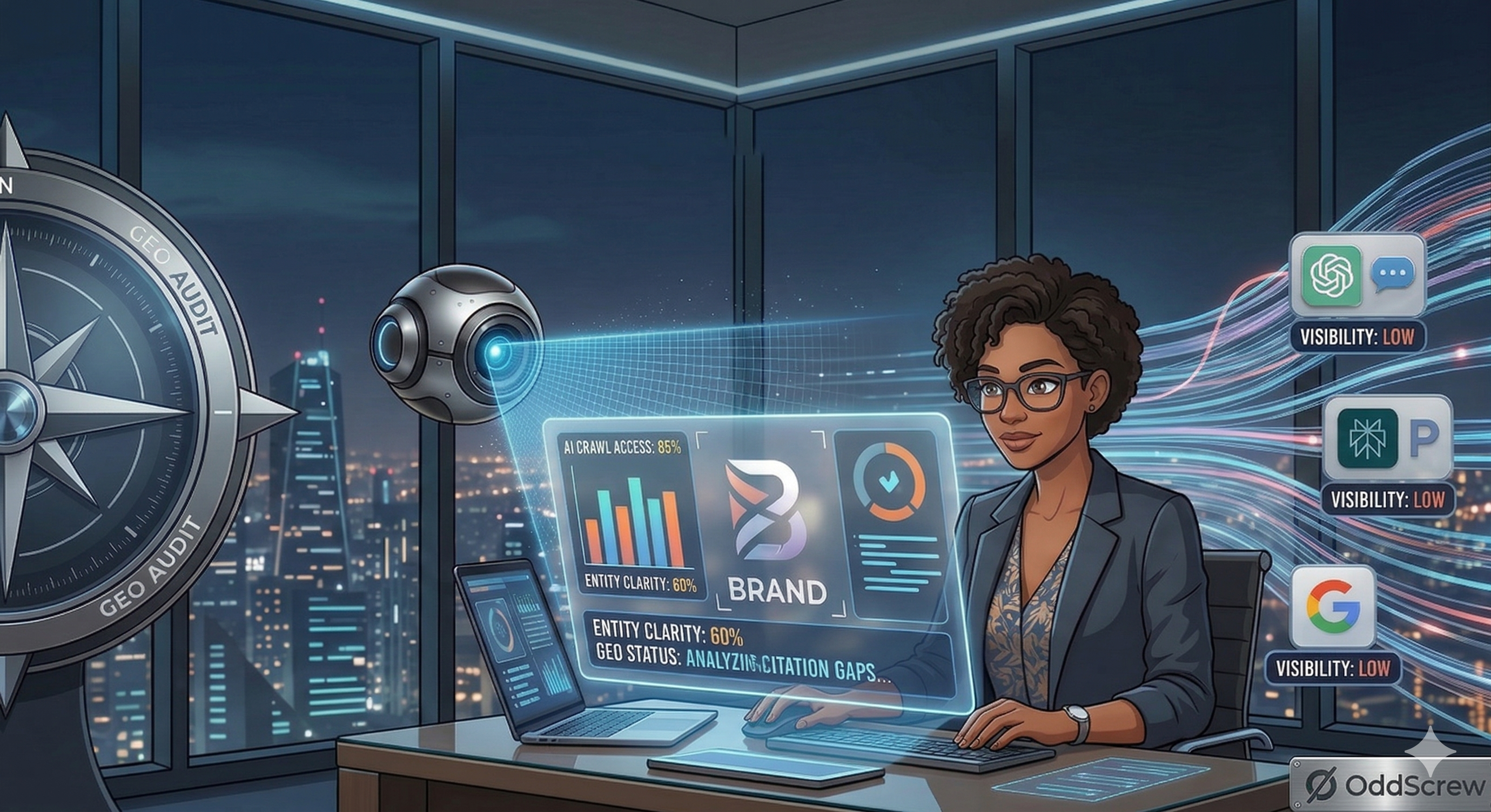
Component 1—AI Crawl Access
Before any optimisation can work, AI engines need to be able to find and read your content. This is the most commonly overlooked issue in GEO—and the most immediately fixable. Many brands are unknowingly blocking AI crawlers through their robots.txt file or CDN security settings. Cloudflare, for example, changed its default configuration in 2024 to block AI bots—meaning brands using Cloudflare may have been invisible to AI crawlers without realising it.
What to check: Review your robots.txt file for blocked AI crawlers. Check server logs for user agents including ChatGPT-User, GPTBot, PerplexityBot, and ClaudeBot. Verify that your key pages render correctly without JavaScript, since most AI crawlers cannot execute it.
Component 2—Entity Clarity and Contextual Accuracy
AI engines build their understanding of your brand by cross-referencing multiple sources. If your brand is described differently across your website, LinkedIn, Google Business Profile, third-party directories, and press mentions—the AI encounters conflicting signals and either produces an inaccurate description or deprioritises you as a source. Getting cited is useless if the engine hallucinates your core services or recommends you for a legacy product you no longer offer.
What to check: Search for your brand name in ChatGPT and Perplexity and read how they describe you. Does the description match your actual positioning? Are the details contextually accurate? Inconsistencies between AI-generated descriptions and your schema markup are the most common—and most fixable—issue found in GEO audits.
Component 3—Content Citation Readiness
This is the heart of the audit. Citation readiness measures whether your content is structured in a way that allows AI engines to extract, summarise, and cite it accurately. AI engines prefer content with clear hierarchical headings, direct answers in the first sentence of each section, FAQ formatting, schema markup, and specific data points with verifiable sources.
What to check: Take your five most important pages and ask—does each section open with a direct answer? Are there FAQ sections that mirror how customers phrase questions? Is schema markup implemented correctly for Article, FAQ, HowTo, and Organisation? Is the content free of vague claims that an AI engine cannot verify?
Component 4—Trust and Authority Signals
AI engines apply E-E-A-T signals—Experience, Expertise, Authoritativeness, Trustworthiness—when deciding which sources to cite. As we covered in GEO, AEO, AI SEO—What’s the Difference, AI engines are significantly more biased towards earned media than Google is. ChatGPT in particular consistently suppresses brand-owned content in favour of third-party editorial sources. This means your own website, however well optimised, is not sufficient on its own.
What to check: How many authoritative third-party publications mention your brand? Are your authors named and credentialled? Do you have consistent citations in industry publications, review platforms, and community forums? Is your brand mentioned on Reddit, LinkedIn, or YouTube—the three platforms most consistently cited by major AI engines?
Component 5—Competitive Citation Gap
The Citation Gap is the difference between where your brand appears in AI-generated answers and where your competitors do. This is the most commercially important insight an audit produces—because it tells you exactly which queries your competitors are winning and you are not.
What to check: Run your 10–15 most important category queries across ChatGPT, Perplexity, and Google AI Overviews. Document which brands appear for each query. For every query where a competitor appears and you don’t, that’s a citation gap—and a direct content and earned media opportunity.
In practice, the Citation Gap map is consistently the single most valuable output of any GEO audit—transforming a vague sense of AI invisibility into a precise, prioritised list of actions every stakeholder can understand and act on.
📊 THE ODDSCREW CITATION SCORE (OCS)
The OddScrew Citation Score (OCS) is a structured framework used to evaluate a brand’s AI visibility out of 100. It assesses performance across five weighted dimensions, prioritizing the signals that most influence AI preference.📐Scoring Dimension
- Presence & Crawlability (15 pts): Can AI bots access your site, and how often do you appear across core industry prompts?
- Content Citation Readiness (15 pts): Is your architecture (Schema, FAQs, headers) built for machine extraction?
- Contextual Accuracy (20 pts): When cited, does the AI sell your current services correctly without hallucinating?
- Trust & Attribution (25 pts): Are you earning mentions in the specific third-party publications that LLMs prioritize?
- Recommendation Strength (25 pts): Are you listed as a generic option, or highlighted as the definitive “best choice” over your competitors?
📈 How to Interpret Your Score
- Below 50 → Foundational SEO/AEO issues may need to be addressed before GEO efforts are effective
- 50–75 → Strong technical base with meaningful citation gaps to close
- 75+ → Well-positioned; focus shifts to expanding competitive Share of Voice
3. How to Run Your Audit—Step by Step
You do not need specialist tools to run your first GEO audit. The most reliable method is a structured manual process across the three major AI platforms. Here is exactly how to do it.
Step 1—Build Your Query Set
Before you open a single AI platform, define the 10–15 queries that matter most to your business. These should reflect how your potential customers actually phrase questions to AI engines—conversational, specific, and intent-driven.
Structure your queries across three intent types:
- Awareness queries—’What is [your service category]?’ or ‘How does [your industry] work?’
- Consideration queries—’What is the best [your service] for [customer type]?’ or ‘[Your service] vs [alternative]‘
- Decision queries—’Which [your service] agency should I use?’ or ‘Who are the leading [your category] providers?’
Use the exact language your customers use—not your internal terminology. If your customers say ‘marketing agency’ rather than ‘integrated communications partner’, write the query accordingly.
Step 2—Test for Intent Variations
Do not just type your primary keyword into ChatGPT and call it a day. Large Language Models are highly sensitive to phrasing and context.
For example, if you filled in the blanks from Step 1 with “digital PR agency,” testing only that broad term will make your audit fundamentally inaccurate.
You must test across three levels of intent:
- The Broad Search: “What are the top digital PR agencies?”
- The Niche Search: “What is the best digital PR agency for a B2B SaaS product launch?”
- The Comparison Search: “Which is better for startup visibility: a traditional PR firm or a digital PR agency?”
AI engines filter heavily by context. You might be completely invisible for the broad search, but highly recommended for the niche search—or vice versa. Documenting how your visibility shifts based on the user’s exact phrasing is the most critical part of this audit.
Step 3—Check Your Entity Representation
Ask each AI platform directly: ‘What is [your brand name]?’ and ‘What does [your brand name] do?’ Read the response carefully. Does it accurately describe your positioning? Are the details correct—location, services, specialisms, founding date? Does it align with how you describe yourself on your own website and across your brand profiles?
Any inaccuracy is an entity signal problem. The fix is to standardise your brand description across every digital touchpoint—your website About page, LinkedIn company profile, Google Business Profile, industry directories, and schema markup—so that AI engines receive consistent, unambiguous signals about who you are and what you do.
Step 4—Audit Your Technical AI Accessibility
Visit your website with JavaScript disabled. If your core content—service descriptions, about page, key articles—disappears or becomes unreadable, AI crawlers are likely seeing the same empty page. Most AI crawlers cannot execute JavaScript.
Check your robots.txt file at yourdomain.com/robots.txt and look for any Disallow rules that may be blocking AI crawlers. The user agents to check for are: GPTBot (OpenAI), PerplexityBot, ClaudeBot (Anthropic), and Google-Extended. If any of these are blocked, your content is invisible to those engines regardless of how well optimised it is.
Step 5—Map Your Citation Gap
Compile your query results into a simple table: query in the left column, then a column for each AI platform, with a tick or cross for whether your brand appeared. Where competitors appear and you don’t, highlight the row. These highlighted rows are your Citation Gap—your most immediate GEO priorities.
For each gap, ask two questions: does a piece of content exist on your site that directly answers this query? And does an authoritative third-party source mention your brand in the context of this query? If the answer to either is no, you have found your next action.
⚡ QUICK WIN
Before doing anything else, run this one search right now: open ChatGPT and type ‘What is the best [your service] for [your primary customer type]?’ Note who appears. If you are not in the answer—that gap is costing you customers today. That is your GEO brief in one search
4. What Your Results Mean—And What to Do Next
Once you have your audit results, the response depends on what you find. Here is how to interpret the most common scenarios:
Your brand doesn’t appear in any AI answers
This is the Citation Gap in its most complete form—and it’s more common than you’d think. Research shows that even brands with strong traditional SEO rankings are frequently absent from AI-generated answers. The most likely causes are: AI crawlers being blocked, entity signals that are inconsistent or too weak for AI engines to resolve, no earned media presence in sources AI engines trust, or content that isn’t structured for citation.
Priority actions: Fix technical access first. Standardise entity signals across all platforms. Then focus on earning a single high-authority third-party mention in a publication AI engines cite in your vertical—one strong earned media placement can unlock citation visibility that months of on-site work cannot.
Your brand appears but is described inaccurately
This is an entity clarity problem. AI engines are drawing on conflicting signals and constructing a composite—often incorrect—description. The fix is to make the correct description so consistently present across so many sources that it becomes the unambiguous signal the AI resolves to.
Priority actions: Audit every brand profile and directory listing. Standardise your positioning statement—one clear, consistent description that appears on your website, LinkedIn, Google Business Profile, and schema markup. Add sameAs markup to your schema to help AI engines confirm your brand identity across platforms.
You appear for some queries but not others
This is the most actionable audit outcome. It tells you precisely which topics you have authority on and which you don’t—at least in AI engines’ estimation. The gaps usually correspond to topics where you have no dedicated content or no earned media coverage.
Priority actions: For each missing query, create a dedicated answer asset—a piece of content that opens with a direct, specific answer to that exact question in the first 50 words. Then identify which publications AI engines cite for that query and pursue a mention or feature in those specific sources.
You appear consistently but competitors rank above you
This is a Share of Voice problem—you are in the game but not winning it. AI engines are citing you but not leading with you. The issue is typically that a competitor has stronger earned media authority, more comprehensive justification content, or better entity recognition for the specific query type.
Priority actions: Analyse which sources AI engines cite when recommending your competitor ahead of you. Those are your priority earned media targets. Build comparison content that explicitly positions your brand against the competitor—AI engines cite comparison content heavily for consideration queries.
5. Tools to Support Your Audit: Snapshots vs. Diagnostics
The landscape of AI visibility software has expanded significantly, but it is still in its infancy. While you can use a mix of free and paid tools to get a baseline understanding of your presence, it is critical to understand their limits. Automated tools can give you a 30-day snapshot of whether your brand exists in an LLM’s training data. But raw data doesn’t tell you why ChatGPT chose your competitor over you, or what structured data you are missing to fix it. DIY tools provide the snapshot; fixing the root problem requires a strategic diagnostic.
The DIY Snapshots
- Manual Auditing (Free): The most reliable starting point remains manual testing directly in ChatGPT, Perplexity, and Google AI Overviews. Tools cannot fully replace reading the actual AI responses your customers are seeing.
- GA4 Traffic Tracking (Free): Configure a custom channel grouping in Google Analytics to capture AI referral traffic (sources like chatgpt.com, perplexity.ai, claude.ai).
- Structured Schema Validation (Free): Use Google’s Rich Results Test and Schema.org’s validator to confirm your structured data is correctly implemented.
- Ongoing Monitoring (Paid): Dedicated GEO monitoring platforms like Semrush’s AI Visibility Toolkit, Otterly.ai, and Wellows can automate prompt tracking and provide Share of Voice benchmarking.
The Diagnostic Route
If running a manual audit across multiple platforms feels too resource-heavy for your internal team, partnering with a specialist GEO agency is the most efficient alternative. A specialized agency won’t just pull automated data; they will manually map your citation network, identify the specific architecture gaps, and deliver a prioritized blueprint to get you recommended.
📌 TOOL REALITY CHECK
No automated tool yet comprehensively tracks AI citation rates across all platforms with full accuracy. AI responses are variable by design—the same query can produce meaningfully different answers across sessions. Use tools for trend tracking and directional insight. Use manual audits—or a specialist agency—for the granular, qualitative understanding that tools cannot replicate.
6. From Audit to Action—Your 90-Day GEO Plan
An audit without a response plan is just a document. The following 90-day framework is the exact blueprint we use at OddScrew to move brands from a GEO audit to active AI visibility— structured to fix the highest-impact issues first and build compounding citation authority over time.
Days 1–30—Fix the Foundation
- Resolve all AI crawl access issues—robots.txt, CDN settings, JavaScript rendering
- Standardise entity signals across website, LinkedIn, Google Business Profile, and schema markup
- Implement or correct Article, FAQ, Organisation, and HowTo schema on key pages
- Rewrite the opening paragraph of your five most important pages so each leads with a direct, citable answer
Days 31–60—Build Citation Assets
- Create answer assets for your top five Citation Gap queries—one dedicated piece per query, opening with a direct answer in the first 50 words
- Add FAQ sections to all major service pages, written in the exact language customers use in AI queries
- Identify the top three authoritative publications AI engines cite in your vertical and begin outreach for features or expert commentary
- Build or update comparison content positioning your brand against the two or three alternatives AI engines recommend instead of you
Days 61–90—Measure, Defend and Iterate
- Re-run your full query set across all three platforms and compare results against your Day 1 baseline
- Calculate your Share of Voice improvement—what percentage of your tracked queries now include your brand?
- Identify any new Citation Gaps that have emerged as competitors respond
- Set your monthly monitoring cadence and assign ownership so GEO tracking becomes a recurring discipline rather than a one-time project
📊 WHAT GOOD LOOKS LIKE
B2B SaaS companies are currently featured in 43% of relevant AI responses. Retail averages 18%. Healthcare sits at 31%, financial services at 29%, according to Conductor’s 2026 AEO/GEO Benchmarks Report. Use your industry benchmark as your target—not as a ceiling.
7. Frequently Asked Questions
Run prompt monitoring monthly—track the same query set across your core AI platforms and document changes in citation frequency and positioning. Run a full technical and content audit quarterly, since schema errors and crawl issues can emerge as your site evolves. Between 40% and 60% of cited sources change month-to-month across ChatGPT and Google AI Mode, making monthly monitoring essential rather than optional.
Technical fixes—resolving crawl access and entity signal inconsistencies—can produce measurable improvements in AI citation frequency within four to six weeks. Content citation improvements typically take eight to twelve weeks as new content gets indexed and AI engines update their knowledge. Earned media-driven improvements take the longest—three to six months—but tend to produce the most durable citation authority. Some brands have reported measurable improvements in AI citations within ten days of implementing targeted technical fixes.
No—though they share some technical components. An SEO audit focuses on your website’s health and keyword rankings within Google’s traditional results. A GEO audit examines your brand’s footprint across the entire information ecosystem AI engines draw from—including third-party publications, community platforms, review sites, and your brand’s entity consistency across all digital channels. A GEO audit will often surface issues that an SEO audit misses entirely, particularly around earned media coverage and entity fragmentation.
Yes—and this is one of the most important nuances in GEO. Different AI engines source their answers differently. ChatGPT heavily favours earned media and suppresses brand-owned content. Perplexity takes a more balanced approach and is the most transparent about its sources. Google AI Overviews draw heavily from existing Google ranking signals. A brand that is well-cited on one platform may be invisible on another. Limiting your audit to one platform gives you an incomplete—and potentially misleading—picture of your actual AI visibility.
This is an entity clarity problem and it is fixable. The solution is to make the correct description so consistently present across so many authoritative sources that AI engines have no ambiguity to resolve. Standardise your positioning statement across your website, LinkedIn, Google Business Profile, schema markup, and any third-party directory listings. Add sameAs schema markup that explicitly links your brand profiles together. Pursue a correction in any third-party sources that contain inaccurate information—these external signals carry significant weight in how AI engines construct their understanding of your brand.
Final Thought: You Cannot Close a Gap You Have Not Measured
The brands that will dominate AI search in the next three years are not necessarily the ones with the biggest budgets or the longest track records. They are the ones that started measuring their AI visibility early—when the gap between them and their competitors was still closable.
Every week without an audit is a week your competitors may be building citation authority that becomes increasingly difficult to displace. AI engines, like traditional search engines before them, reward early movers disproportionately. The Citation Gap is real, it is measurable, and it is yours to close—but only once you know exactly where it is.
The audit takes less time than most brands expect. The advantage it creates lasts far longer.
🚀 READY TO SEE YOUR BLIND SPOTS?
Running a comprehensive GEO audit takes time, precision, and an understanding of how different LLMs parse information. If you don’t have the team capacity to run this manually, we can do the heavy lifting for you.
Book a complimentary Citation Gap Analysis with OddScrew. We will map exactly which earned media, structured data, and content gaps are keeping you off the AI shortlist, and show you exactly what it will take to close the gap between you and your competitors.
The audit takes 48 hours. The advantage lasts years.