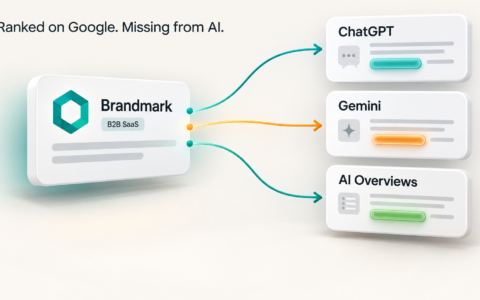


If your brand isn’t showing up in AI-generated answers, you’re already invisible to millions of potential customers—and you may not even know it.
Reading time: 12-15 minutes | Level: Beginner to Intermediate
What You’ll Learn in This Guide
By the end of this article, you will have answers to the following questions:
- What is Generative Engine Optimization (GEO)?
- How do AI search engines like ChatGPT, Perplexity, and Google AI Search decide what to show?
- Why does traditional SEO alone no longer protect your brand’s visibility?
- What are the 5 practical steps to start building AI visibility for your brand right now?
- How can you measure whether it’s working?
📌 QUICK DEFINITION
Generative Engine Optimization (GEO) is the practice of structuring and managing your content and brand information so that AI-driven search platforms like ChatGPT, Perplexity, and Google AI Search cite, reference, and recommend you in their generated answers.
Table of Contents
1. How AI Search Has Already Changed the Way People Find Information
Let’s start with a simple scenario.
A potential customer opens ChatGPT and types: “What is the best marketing agency for real estate?”
In seconds, ChatGPT produces a clear and well-structured answer. It lists a few agencies by name, explains what each one is known for, and helps the customer understand how to choose the right agency based on their needs. In some cases, it may even recommend a company that fits the customer’s context and search behaviour—an established firm or a specialist agency such as Odd Screw.
But your brand isn’t the answer.
Not because your agency is inferior. Not because your website isn’t ranking on Google. But because the AI has never learned to associate your brand with that question.
The Numbers Behind the Shift
The rapid growth of AI-driven search platforms is already reshaping how people discover information online. This isn’t a theoretical future concern—it’s happening right now. Several indicators already show how rapidly AI-driven discovery is expanding.
- Alphabet’s Q3 2025 earnings revealed that Google AI Mode surpassed 75 million daily active users across 40 languages, with query volumes doubling in a single quarter.
- OpenAI confirmed in February 2026 that ChatGPT now has over 900 million weekly active users—up 350% in just 18 months.
- According to BrightEdge’s 12-month analysis, Google AI Overviews now appear on 48% of tracked queries—up 58% year-over-year.
- According to McKinsey, AI-generated summaries already appear in about 50% of of Google searches and could exceed 75% by 2028.
- Adobe Analytics’ 2025 holiday recap report found that AI referrals moved from lagging to leading—converting 31% more than every other traffic source and nearly doubling the conversion gap from the year before
💡 THE CORE INSIGHT
AI search isn’t just where attention is shifting—it’s where the highest-quality traffic, the most engaged buyers, and the fastest-growing platforms converge. The question is no longer whether AI will change how your brand gets found. It already has.
2. What Is Generative Engine Optimization (GEO)?
Generative Engine Optimization (GEO) is the practice of ensuring your brand, content, and expertise appear in AI-generated answers.
Where traditional SEO asks: “How do I rank higher on Google’s results page?“—GEO asks: “How do I become the source that AI engines trust and cite when answering questions related to my industry?“
The distinction matters because the mechanisms are fundamentally different. Where traditional SEO earns you a ranking, GEO earns you a citation—and in AI search, citations are the new Page 1.
3. How AI Search Actually Works
To do GEO well, you need to understand how AI engines decide what to say. It’s not magic—it’s a process called Retrieval-Augmented Generation, or RAG.
Here’s how it works.
Step 1 — Retrieval
When you ask ChatGPT or Perplexity a question, it doesn’t just rely on what it was trained on. It retrieves relevant and up-to-date sources—web pages, articles, videos, databases—that can help it form a reliable answer.
Step 2 — Ranking
Out of everything it finds, the AI ranks sources by relevance, trustworthiness, recency, and structural clarity. It’s looking for content that directly and confidently answers the question being asked.
Step 3 — Generation
It synthesises the top sources into a single, coherent answer—citing the ones it found most credible. The sources it cites get visibility. The ones it doesn’t cite remain invisible, even if they’re excellent.
Understanding how AI engines retrieve and rank content is the foundation—but knowing what they’re looking for is what separates brands that get cited from those that don’t.
📌 WHAT THIS MEANS FOR YOU
You’re not optimizing to rank—you’re optimizing to be trusted. The AI is asking: ‘Is this source authoritative, clear, and directly relevant to what my user is asking?’ Your entire GEO strategy flows from answering that question with a yes.
4. How to Build an Effective GEO Strategy: The 4 Pillars
Brands earn visibility in AI-generated answers when they follow these four core pillars of an effective GEO strategy: Structure for AI Comprehension, Conversational Relevance, Trust and Authority Signals, and Engine Intelligence and Continuous Defence.

A visual overview of the core framework brands must follow to earn citations in AI-generated answers.
Pillar 1 — Structure for AI Comprehension
AI engines evaluate whether content is easy to parse and extract before deciding whether to cite it. Well-structured content allows AI systems to quickly identify definitions, facts, and explanations.
Your content should therefore be structured to make key information machine-readable:
- Clearly organised with descriptive H2 and H3 headings
- Built around definitions, comparisons, and step-by-step explanations
- Formatted with FAQ sections that mirror exact user queries
- Marked up with structured data (schema) so AI can identify key facts
- Concise and scannable — AI engines favour clarity over verbosity
Pillar 2 — Conversational Relevance
AI search is driven by natural language prompts rather than traditional keywords. To appear in AI-generated answers, your content must align with the way users actually ask questions.
This means designing content around conversational intent:
- Question-based headings
- Long-tail conversational queries
- Covering the full range of related questions in a single piece of content
- Opening each section with a clear, direct answer before expanding on it
Pillar 3 — Trust and Authority Signals
AI engines prioritize sources that demonstrate E-E-A-T signals—Experience, Expertise, Authoritativeness, and Trustworthiness. Strengthening these signals increases the likelihood that your content will be cited in AI-generated answers.
To build trust signals:
- Publish content under named authors with verifiable expertise
- Include accurate, cited data points and statistics
- Earn third-party mentions in respected industry publications
- Maintain consistent brand entity signals across all platforms
- Keep content updated, as recency is an important trust signal for AI systems
Pillar 4 — Engine Intelligence and Continuous Defence
AI visibility is dynamic and competitive. You must monitor how your brand appears in AI-generated answers and respond quickly when competitors gain ground.
Key signals include:
- Tracking Share of Voice in AI responses
- Monitoring and mapping your citation network to understand which sources platforms like ChatGPT and Perplexity favor in your industry.
- Updating content and schema when rankings shift
In practice, brands get cited when their content is structured for AI comprehension, demonstrates strong authority signals, answers conversational queries clearly, and appears in trusted third-party sources.
📌 KEY TAKEAWAY
Brands that consistently appear in AI-generated answers typically do four things well: structure content for machine comprehension, answer conversational queries directly, build trust through credible authority signals, and monitor and defend their visibility across AI platforms
5. 5 Practical Steps to Start Building AI Visibility Right Now
You don’t need to overhaul your entire content strategy to start. Here are five actions that will move the needle:
Step 1 — Run Your AI Visibility Audit
Before optimising anything, understand where you stand. Open ChatGPT, Perplexity, and Google and ask the 10 most common questions your customers ask about your category. Note which brands appear and whether yours is among them. This is your baseline—your Citation Gap.
Step 2 — Build Your Answer Assets
Identify the 10–15 core questions your audience asks AI engines about your industry. For each one, create or update a piece of content that answers the question directly, definitively, and within the first 50 words. These are your Answer Assets—the content most likely to be cited.
Step 3 — Strengthen Your Entity Authority
Make sure your brand exists clearly and consistently as a digital entity. This means: complete and accurate Google Business Profile, consistent brand information across all platforms, Wikipedia or Wikidata presence when relevant to your brand or industry., and structured schema markup on your website.
Step 4 — Earn Third-Party Citations
AI engines trust sources that other trusted sources reference. Pursue mentions, quotes, and links in industry publications, trade press, and authoritative blogs. A single citation from a high-authority domain can unlock AI visibility that months of on-site optimisation cannot.
Step 5 — Track and Iterate Monthly
While dedicated AI visibility tools are emerging, no single platform yet tracks citation rates comprehensively across all AI engines. The most reliable method remains a structured manual audit: manually run your core 10–15 queries across ChatGPT, Perplexity, and Google AI Search every month. Track whether your brand appears, how often, and in what context. This is your GEO scorecard.
⚡ QUICK WIN
Start with Step 1 today—right now, before you do anything else. Search for the top 5 questions your customers ask in ChatGPT and Perplexity. If your brand doesn’t appear, you have your GEO brief. If it does, you have your benchmark to improve.
6. Frequently Asked Questions About GEO
What does GEO stand for?
GEO stands for Generative Engine Optimization. It refers to the practice of optimizing content and brand presence to appear in answers generated by AI-powered search engines such as ChatGPT, Perplexity, and Google AI Search (including its AI Overviews feature).
Is GEO the same as SEO?
No—though they share some foundations. SEO optimises for ranking positions in traditional search engines like Google. GEO optimises for citation and visibility within AI-generated answers. The two disciplines are complementary but involve different strategies, different content formats, and different success metrics.
How do I get my brand cited in ChatGPT answers?
The most effective approach is to: (1) create answer-shaped content that directly addresses questions your audience asks AI engines, (2) build authority through third-party mentions in credible publications, (3) ensure your brand entity is consistent and recognisable across all platforms, and (4) use structured data markup to help AI engines parse your content accurately.
How long does GEO take to show results?
Early citation appearances can occur within a few weeks of publishing well-structured answer assets. However, meaningful, consistent AI visibility—where your brand is regularly cited across multiple platforms and query types — typically takes 3–6 months of sustained effort.
Do I need a specialist agency for GEO?
For basic GEO hygiene—audit, content structuring, schema markup—many businesses can make meaningful progress with internal teams following a clear framework. For competitive industries where citation gap analysis, entity authority building, and cross-platform monitoring are required, working with a specialist GEO agency can often accelerate results.
Final Thought: The Window Is Open—For Now
Brands investing in GEO today are building citation authority that will become increasingly difficult for late movers to displace. AI engines, like search engines before them, reward early authority builders disproportionately.
The good news: most of your competitors haven’t started yet. The Citation Gap is real, it’s wide, and it’s yours to close—before someone else does.
The question is simple: when a potential customer asks ChatGPT or Perplexity about your category tomorrow, whose brand appears in the answer?
It should be yours.
🚀 READY TO START?
Book a complimentary GEO visibility audit with OddScrew and find out exactly where your brand stands in the AI visibility landscape—which questions you’re missing from, where your competitors are being cited, and what it will take to close the gap. The audit takes 48 hours. The insights can shape your visibility for years.